
Chiyoda
In all honesty, we walked through the park without stopping too much to get to the East Garden of the Imperial Palace.
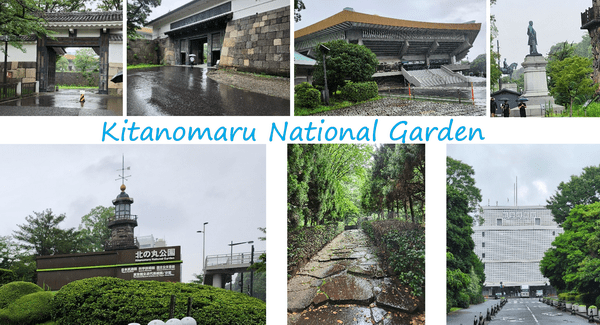
The large and impressive historical gate Tayasu-mon (1635) caught our attention and instead of walking along the street we opted to cross this beautiful large green space open to the public since 1969. The mature trees of the site give a freshness, even if the day was already rainy. The second gate, Shimizu-mon, is also an option to access the garden. Both have been part of the Edo Castle for many years. The moat and the fortification walls are in the same style as the rest of the Tokyo Imperial Palace.
The park was the residence of the extended Tayasu-Tokugawa family from 1603 to 1867, and was then the site of the military headquarters of the Imperial Guard until the end of World War II. In addition to the natural setting of this bird oasis, the site is home to the Nippon Budokan, the Science Museum, the National Archives of Japan, and the National Museum of Modern Art in Tokyo.
On the outskirts of the park, a bronze equestrian statue of Prince Kitashirakawa Yoshihisa (1847-1895), former head of the Guard, is installed there.
The park reveals its colors in spring with the many cherry blossoms and in autumn with the maple and oak leaves that turn to red, orange and yellow colors.
You can combine this visit with the East Gardens of the Imperial Palace, the Inui-bori park and the Yasukuni-jinja shrine which are nearby.
Tayasu-mon
Of the 36 original main gates of Edo Castle, only a few have survived over the years, and two of them are on the Kitanomaru Garden side: Tayasu-mon and Shimizu-mon.
According to the inscription, Tayasu-mon is an entrance that dates back to 1636, making it the oldest entrance gate of the fortified site.
When you pass through the first gate, you will face a second entrance, the Tayasu-mon, located at a 90-degree angle to access the park. This style of access, which is found at the Ote-mon and Hirakawa-mon gates, is strategically designed to slow down troops arriving at the site. It is, therefore, a simple defense mechanism known as the Masugata style.
The space between the two entrances is rectangular and surrounded by high stone walls, thus allowing potential invaders to be trapped.
Another historic gate that gives access to the park is Shimizu-mon.
Nippon Budokan
Near the Tayasu-mon entrance, there is a stadium that can host martial arts competitions: karate, judo, aikido, among others. The Nippon Budokan was specially built for the judo events of the 1964 Summer Olympics and was reused in 2020.
With a capacity of more than 14,000 spectators, the arena is also a concert hall and has hosted, among others, the Beatles in 1966, ABBA and Bob Dylan.
Science Museum
There is the Ueno Park Nature and Science Museum and there is the Kitanomaru Park Science Museum. Both are opportunities to touch and experience science.
National Archives of Japan
Open to the public since 1971, some historical government documents are available to be viewed by visitors. This facility is where the priceless historical government archives, dating back to the Edo period of the Tokugawa Shogunate, are preserved. Other documents include administrative documents, national policies, original versions of the old and new Japanese constitutions, and more.
The National Museum of Modern Art, Tokyo
Established in 1952, this museum covers a large collection of modern and contemporary art that dates back to the Meiji era (1868 – 1912), marked by openness to the outside world, to today. The opportunity to study art abroad has had an influence on artistic creations.
Also known as MOMAT, the museum focuses on works after the end of the 19th century with over 13,000 works by Japanese artists in storage, 18 of which are designated as Important National Cultural Properties. The museum displays approximately 200 works at a time.
Not to be confused with the Tokyo National Museum in Ueno Park, the latter mainly covers ancient and medieval Japanese art as well as works from Asia.
For all my posts on Tokyo, click here.
 Simple Travel and Recreation