

Akakusa
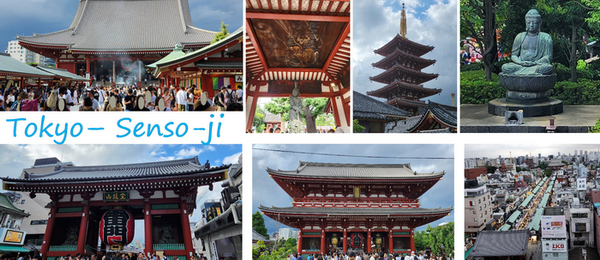
Senso-ji Buddhist Temple is one of Tokyo’s most popular and busy sites with 30 million visitors each year. Getting there is a most spectacular and colorful journey. There are certainly other accesses, but to get to the main building, you will probably go through a typical route: a first gate, a commercial street, a second gate and then arrive at the main temple. The route is flat and for pedestrians only.
The story of the Senso-ji Buddhist Temple is said to have originated from a find in the Sumidagawa River not far from the site. Two brothers, Hinokuma Hamanari and Takenari, regularly went to the river to fish. On more than one occasion the brothers recovered a statue in their net and immediately rejected it until the day, in 628, when they decided to present it to the village chief. The latter sees a message, a revelation and immediately undertakes to protect and venerate the statue. The first site to admire the statue was that of the village chief’s house before the incredible site of Senso-ji was created in 645.
But before going further on Senso-ji, let’s come back to the statue, because it may not be easy for a foreigner like me to understand a few things. I’ve done a lot of research and I hope my conclusions are correct. The site was developed as a veneration of the statue of the divinity Kannon. A deity is associated with higher supernatural powers to watch over those who pay homage to him/her. Kannon is prayed to for her compassion and assistance in overcoming difficulties by spiritually encouraging the faithful to see the light and Kannon is said to be willing to take the brunt of the misfortunes of others. The site where a deity is worshiped then becomes a sacred place.
The official website calls it the statue of Avalokitesvara Bodhisattva (Sho Kanzeon Bosatsu) or simply Kannon. Kannon, a prominent figure on Asian Buddhist sites, has an ambivalent identity, sometimes a man and sometimes with feminine curves; that of Senso-ji would be feminine, with two arms and a face. She would be standing and holding a lotus in one of her hands. Because we cannot see the statue, it has been intentionally hidden for a long time, it is difficult to have accurate and confirmed information on its shape. Note that a statue of Kannon, the same deity, can also be represented seated, and have several faces and multiple arms.
The visit to the site steeped in history is not limited to the main hall. The entire site is worth exploring with its several pretty structures, monuments and dedications, even if the history is sometimes difficult to grasp for foreign visitors. Don’t miss the pagoda, the Asakusa Shrine, the stone bridge, the Shibaraku statue and the Niten-mon gate to name a few.
Several annual events take place in Senso-ji. Check the schedules as some may be for a limited time during the day or even canceled. Popular annual events include:
- January 1: Shinnen Daikito-e – New Year celebration during which the bell is rung 108 times.
- January 1-7: Hatsumode: The site may be busier with worshipers as this period marks the first visit to a shrine or temple in the new year. People often come there to pray for good fortune.
- January 12-18: Onza Hiho Darani-e is a prayer ritual held in the main temple building from January 12 at 6:00 a.m. to January 18 at 6:00 p.m. During the 168 hours, prayers are recited continuously.
- Early February: Setsubun is a traditional event in shrines and temples in Japan that involves throwing beans to mark the arrival of spring. Two dance performances of the seven deities of the fortune usually take place during the day.
- February 8: Hari Kuyo is the time to pay tribute to the needles being rendered at the end of their useful life. Go to the Awashimado Hall to plant them in tofu.
- March 18: Honzonjigen-e – To celebrate the appearance of Kannon, the Golden Dragon Dance takes place during the day.
- March-April: The only opportunity of the year to discover the Denpoin temple and its gardens. During the cherry blossom season, the garden is sometimes especially open to visitors (approximately late March to early April).
- April 8: Bussho-e or Hana Matsuri to glorify the birth of Buddha, a flower festival is organized. Meet at the main temple building at 10:00 am.
- April 2nd Sunday: Shirasagi-no May is the time of year to promote peace. Various rituals take place including the White Heron Dance. The event also takes place on November 3.
- Late April: Nakizumo Crying Baby Festival describes the event well. Parents choose to pay to scare their babies. According to beliefs, a child’s crying is a sign of long life and health. In the arms of a sumo wrestler, two babies (aged 6 months to 2 years) face each other. The winner is the one who cries first.
- May – 3rd full weekend: Sanja Matsuri is the time to celebrate the three founders of the temple. Go to Asakusa Shrine.
- June 18: Yojijosuikaji-e and Hyakumikuyo-e are two festivities that allow worshipers to pray for good health and express gratitude to the Bodhisattva and Buddha.
- July 9 and 10: Shiman Rokusen Nichi/Hozuki-ichi –July 9 and 10 are very special dates for Buddhists. Praying during these days is the equivalent of 46,000 acts of worship.
- Early September: the end of summer is approaching, Asakusa Kaminarimon Bon Obori Dance creates the atmosphere at the rhythm of the sound of the drum. Traditional dances take place between 6 p.m. and 8 p.m. People are invited to participate around the yagura, a flowered platform where dance performances take place.
- October 18: The Kikukuyo-e of Sensoji is a 120-year-old festival that consists of an exchange of bouquets of chrysanthemums (kiku in Japanese). You bring one to give and you leave with another given earlier and blessed by the priests. A custom is to dry the bouquet given and slip it under your pillow to bring luck. Chrysanthemum is associated with the royal family as well as longevity.
- November 3: Shirasagi-no May is a time of year to promote peace. Various rituals take place including the White Heron Dance.
- November 18: Honzonjigen-e – To celebrate the appearance of Kannon, the Golden Dragon Dance takes place during the day.
- Mid-December: Hagoita-Ichi Fair is a popular 3-day fair to buy small lucky ornamental racquets (hagoita in Japanese) made of wood. The traditional shape of these wooden racquets allow you to play hanetsuki, a game similar in concept to badminton, but without a net. This event ties in with “Osame no Kannon no Goennichi”, the time to close the year by connecting with the famous deity of the Kannon site.
Even without a festival, the site is a must-see in Tokyo.
Here are some points of interest which are described below each, having its historical interest:
- Kaminarimon Gate
- Nakamise-dori
- Hozomon Gate
- Omizuya and the Shararyuou statue (Water pavilion)
- Jokoro – incense burner
- Hondo – Main hall
- Nitenmon Gate
- Asakusa Shrine
- Five-Story Pagoda
- The stele of the ancient pagoda
- Nade Botokesan Buddha
- Yogodo hall
- Stone Bridge – Shakkyo
- Awashimado hall
- Zenitzuka Jizoudou hall
- Bentendo Hall
- Rokkakudo
- Hashimoto Yakusi do temple
- Buddha Statues
- Kinryu Gongen / Kuzuryu Gongen
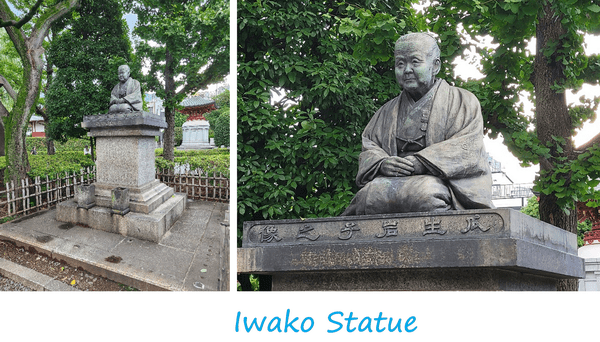
- Iwako Statue
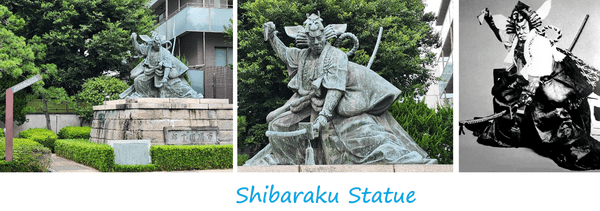
- Shibaraku Statue
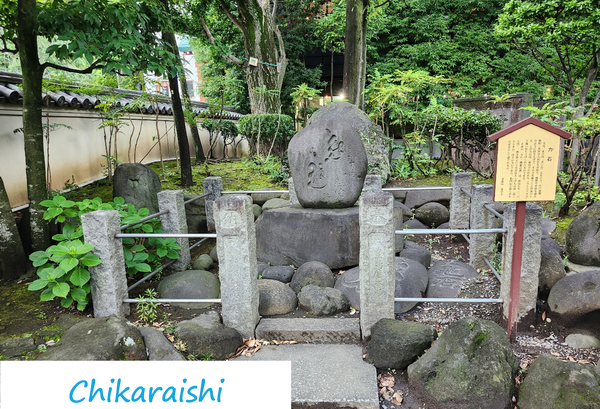
- Chikaraishi
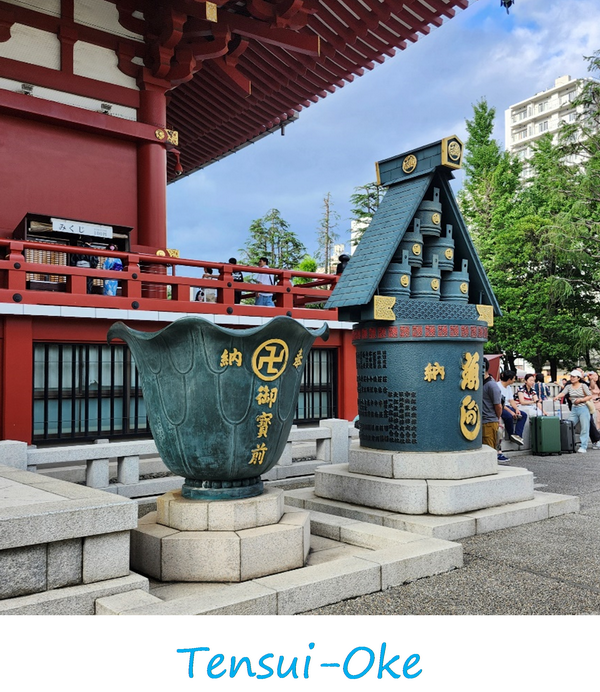
- Tensui-Oke – rain barrel
- Denboin and its garden
- Seated bronze statue of the Bodhisattva
- Bronze Hokyoin-to
- The tree of rebirth
You now understand that you need to allow more than an hour to see the site.
Also linked to Senso-ji, not far but not in the premise, Komagatado temple, if you are interested.
As in the majority of temples and shrines, omikujis and emas are available to visitors. Omikujis are paper strips drawn at random that have a message and the power to predict the future. If it is negative, you can get rid of it by hanging it on a wire in the designated places. If it is positive, luck smiles on you and you will surely create envious people. The emas are wooden plates shaped or with a symbolic image of the site. You can write a wish on them.
To get to the site, the closest stations to Sensoji Temple are Asakusa Station on the Tokyo Metro Ginza Line, Toei Asakusa Line, Tobu Skytree Line, and Tsukuba Express Line. Sensoji Temple is a five-minute walk from one of the stations mentioned.
Site : https://www.senso-ji.jp/english/
1. Kaminari-mon Gate
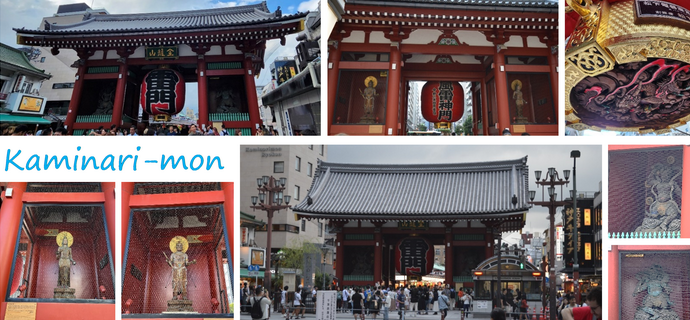
Visiting Senso-ji goes beyond the temple. The first portal, Kaminarimon, is massive and will probably be the first strong image you experience when arriving at the site. Although this is not the only access, it is the most probable. This door, reconstructed in 1960, is the first of two to reach the main building of the Senso-ji temple. It was built by a military commander, Taira no Kinmasa, in gratitude for his promotion.
It is recognized by its flamboyant colors of red, green, white, black and gold in addition to the immense red lantern with black writing suspended in its center.
On the lantern is written “雷門” which can be translated as “Thunder Gate” (雷 = Thunder and 門 = door). Come closer to see the pretty wood carving under the lantern which depicts dragons.
Two imposing statues on either side of the portal also have the same theme. The one on the left is the God of Thunder (Raijin) and on the right the God of Wind (Fujin). Their stern demeanor suggests that they are there to protect the site.
Once you have passed through the gate, you will arrive at Nakamise-dori commercial street where a multitude of traders line up on both sides of the alley. Before you go too far, turn around to see the statues on the other side of the Kaminarimon Gate. We tend to pass by without really noticing it. These are large statues of the god Ten-ryu and the goddess Kin-ryu which were donated to the temple in 1978 to mark the 1350th anniversary of the Kannon statue and are the reason for the creation of the site. Master sculptor Hirashi Denchu produced these sculptures when he was 106 years old. The inscription on this side of the lantern differs from that on the other side and can be translated as “Gate of the Wind and Thunder Gods” (風雷神門).
In the evening, the site is beautifully lit, less crowded and calmer.
2. Nakamise-dori
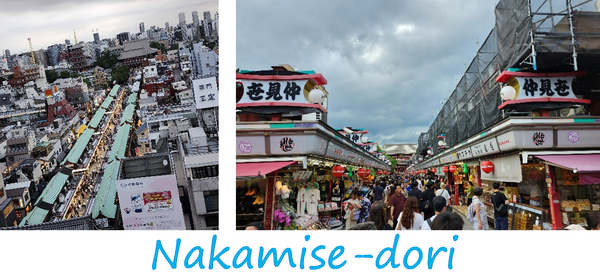
The Nakamise-dori pedestrian street, which connects Kaminarimon (Thunder Gate) to Hozomon (Treasure Gate), is a busy section. It is said to be the oldest commercial street in Tokyo. Dozens of shops line up to offer treats, snacks, local and traditional products.
3. Hozo-mon Gate
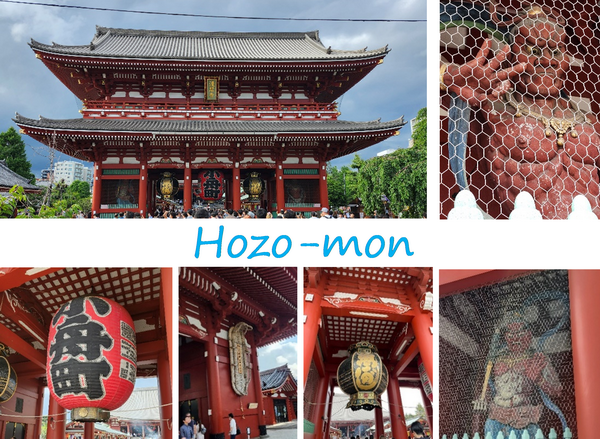
The second portal is wider and higher than the first with its two stories, a triple passage and a lantern (chouchin) under each. The central one is red and the two side lanterns are black and gold. During the celebrations, the lanterns are removed to avoid any impact.
Here we find two imposing statues of Nio, Buddhist guardian deities, hence the original name Nio-mon Gate. On the other side of the gate, a pair of giant straw sandals (waraji) hang on the wall.
Today it is known as “Gate of the Treasure House” because under its roof several works are kept, some of which are designated Japanese national heritage.
4. Omizuya and Shararyuou
For the standardized ritual of purification, the Omizuya (also called Chozuya or Temizuya) of the temples are sometimes more elaborate than others. Obviously with 30 million visitors annually, the Senso-ji temple basin must have a good capacity. The covered water pavilion includes an octagonal pool from which water emerges from the mouths of dragons.
In Japanese culture, dragons are aquatic deities. Many Japanese temples have water spouts in the form of dragons that spit water. This is said to make the water emblematically sacred.
In the center of the pool is a large statue of the Water / Dragon King, Sakara, who stands upright. The sculpture produced by Takamura Koun in 1906 and cast by Tsuda Nobuo shows a leading man in armor with a dragon on his shoulder and whose figure points to the sky above the warrior’s skull.
Note the stunning ceiling painting of the sumi-e dragon. It was produced by Azuma Shoko.
Although it is a necessary stop, the experience is a first step towards the main temple of the exceptional spiritual site.

5. Jokoro – incense burner
After the stage of purification at the water pavilion, the large incense burner (jokoro) is also a method for chasing away spiritual and bodily impurities. Indeed, the faithful take advantage of the smoke produced by the burner to divert the fume to their bodies and heads.
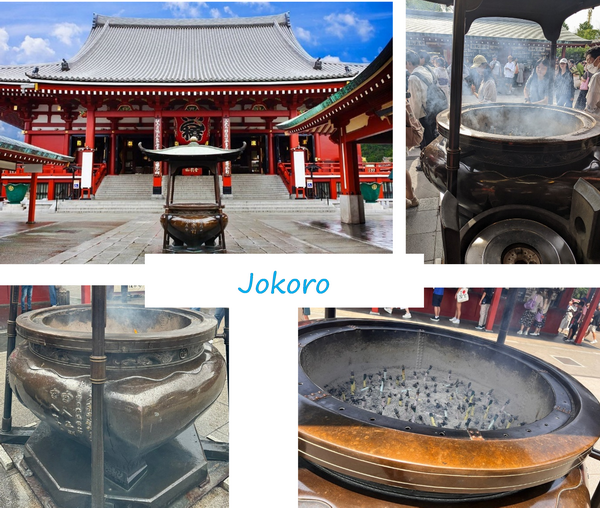
6. Hondo – Main hall
It is, therefore, after passing Kaminari-mon, Nakamise-dori, Hozo-mon and after passing the purification stations that you will arrive at the main prayer site in honor of Kannon Bosatsu.
A stop at the pretty purification pool (chozuya or temizuya) with the dragons is a necessary ritual before continuing. The incense burner (jokoro) is a traditional secret to aid healing, and direct the smoke towards you subtly.
You will notice that the site is surrounded by sculptures. There are even paintings that remind us of the history of the site, that of the origin of the temple where we see the two fishermen.
It is at the main hall (Hondo in Japanese) that people offer their prayers to the deity.
The first site to admire the Kannon statue was the village chief’s house before the incredible site of Senso-ji was built. Specially created for the revered statue, Senso-ji was erected in 645 by a Buddhist priest (Shokai). Following a revelation, Shokai determined that it would be wiser to hide the statue to protect it and this decision continues today. Even a copy of the Kannon Bosatsu statue is not displayed in the room.
The Senso-ji main building has faced numerous fires, but no matter the damages, thanks to donations, the temple was rebuilt and has become, over time, a symbol of rebirth and peace for the Japanese population. The current version is a reconstruction from 1951-1958 after being heavily damaged during the bombings of the Second World War in 1945.
It is appreciated that the site allows visitors to take photos as long as it is done while being respectful towards the faithful of course. It can be difficult, with the number of sites visited, to remember what was there. Here the paintings on the ceiling are a beautiful example of Japanese art. There is, among other things, a superb image of a dragon.
The style and construction appear to follow traditional Japanese techniques. The exterior of the temple, with its wavy roof at a pronounced angle with the corners slightly raised, is characteristic of Japanese architecture. The flamboyant red of the building stands out. The wooden structures have given way to a little more concrete for the fireproof and solid aspect while keeping traditional aspects.

7. Niten-mon Gate
Although this gate is not the most majestic or flamboyant, it has incredible historical importance, recognized as an important cultural property by the Japanese government.
Smaller than the others and a little setback from the current standard route, it was the first gate to the site, when people arrived by boat from the Sumida River side. This entrance, located to the east (right) of the main temple, is also one of the rare structures not to have been damaged by the Second World War.
The view is pretty from this entrance to the temple with the pagoda in the background.
Built in 1618, this architectural work was part of the Toshogu Shrine of Ueno. A fire ravaged the Toshogu site of Ueno, leaving only the gate which was then transferred to Senso-ji.
Just like the other access points, there are also statues guarding the site known as Zochoten and Jikokuten. The original statues, having been destroyed in the 19th century, the ones you see in front of you, are those from the Kanei-ji temple of Ueno. Notice the fierce eyes of the statues. Impressive!
It’s a gripping passage full of history.

8. Asakusa Shrine
On the site of the Senso-ji Buddhist temple is the Asakusa Shinto shrine which confirms the harmony of the two religions. In 1649, immediately after the reconstruction of the site’s pagoda, shogun Tokugawa Iemitsu continued to expand the site by adding new structures, including this one in honor of the three men behind the creation of the Senso-ji site.
Two of these men are the brothers Hinokuma Hamanari and Hinokuma Takenari who fished the statuette of Bosatsu Kannon from the Sumida River in 628. The third is the village chief, Hajino Nakamoto who believed intensely in the divinity collected by the brothers to convert part of his properties into a place of contemplation.
The three men are considered the founders of the temple and this shrine honors them.
The sanctuary is located to the right of the main building and is one of the rare sites to have survived the bombings of 1945.
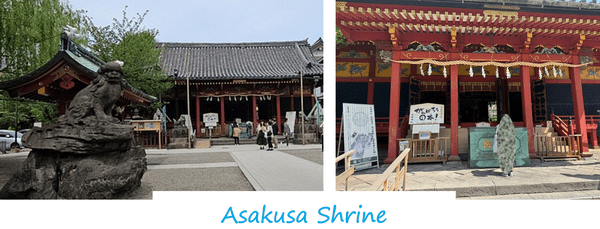
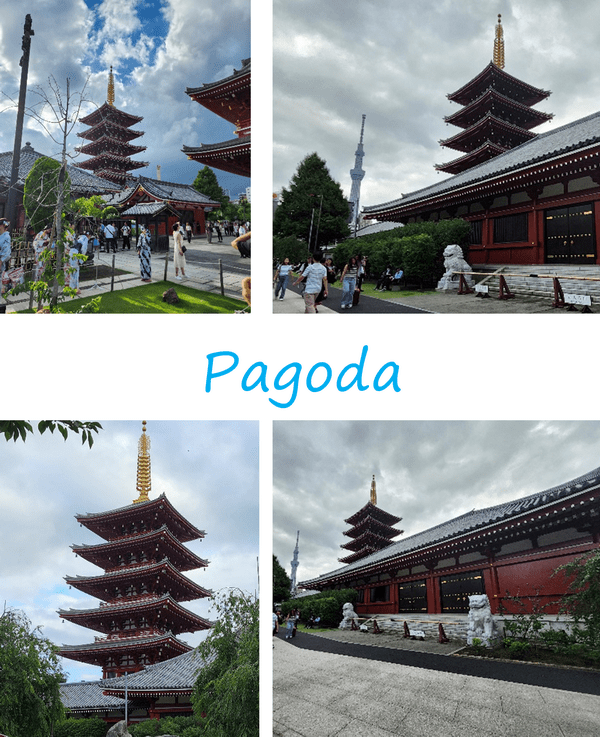
9. Five-Story Pagoda
Pagodas have long been introduced to Buddhist religious sites. In Japan, the pagoda is a secondary element of a Buddhist site even if its style is grandiose. Religious relics are kept there and serve as an eternal resting place for certain Buddhist priests.
The pagodas are all different in style, architecture and color making them attractions in themselves. Over time and regions, styles have been adapted to the needs and image of the region. This is a structure that remained mainly in East Asia. The Japanese adapted the style to fit with the realities of the country.
Indeed, Japan faces numerous and sometimes significant earthquakes. Many pagodas are constructed of wood, and although less resistant to fire and insects, their nail-free construction is flexible enough to move with and against ground movements. Today, they are integrating more solid elements such as steel to better anchor the central part which often serves as access to the floors.
It is incredible that a 5-story Senso-ji pagoda has been part of the city’s decor for over a millennium. We, therefore, understand that although the structure is no longer the original one, it has been considered a national treasure since 1911, a sign that its historical importance is not new.
It is said that at one time there were 2 pagodas on the Senso-ji site. Despite all the setbacks of mother nature, accidents and wars, one of the pagodas has always been rebuilt, to keep the tradition alive.
• 942: First pagoda on the site (Goju-no-To)
• 1648: Reconstruction by shogun Tokugawa Iemitsu
• 1945: Large parts of the Senso-ji site including the pagoda were destroyed during World War II (March 10, 1945)
• 1958: Temple and pagoda rebuilt with new types of materials
• 1973: The pagoda (Goju-no-To) was rebuilt again but this time with a steel structure.
The one you see now has been moved from its original base but is still on the Senso-ji site. It incorporates stronger materials such as steel to better ink the central part.
With its 5 levels and the Sorin, the pagoda is more than 53 meters high from the ground. Assuming that a standard floor is around 3 meters, this is the equivalent of a construction of around 17-18 floors. It is the second tallest pagoda in Japan after Toji temple in Kyoto which measures 56 meters.
From the ground’s point of view, each floor appears to have the same format as a tower. Difficult to confirm, because it could be an optical illusion due to the roofs of each level overhanging very widely and the ends being curved up. Without this extension on each floor, the construction would be slimmer and modeled like a tower.
Each floor of a 5-tiered Japanese Buddhist pagoda has the same symbolization starting from the bottom and this one is no exception: Earth, water, fire, wind/air and void or space or universe. Pagodas do not serve as an observatory, but as a spiritual place of contemplation often linked to the deceased.
Commemorative plaques of deceased believers are kept on the site which is not accessible to visitors except during certain rituals. In 1966, the Royal Isurumuniya Temple located in Sri Lanka donated relics of Buddha which are now kept on the top floor of the Senso-ji pagoda.
The Senso-ji pagoda is the only 5-story pagoda in Tokyo and it is considered one of the most beautiful in the country. It is easily accessible and the evening lighting gives an incredible, beautiful, mystical dimension to the site.
Some argue that ultimately the Tokyo Skytree is based on the principles of central support such as pagodas. It is interesting to see how such traditional practices can still be applied to today’s constructions. You have the chance on the Senso-ji site to take an image of these two constructions from such distant periods with such marked similarities
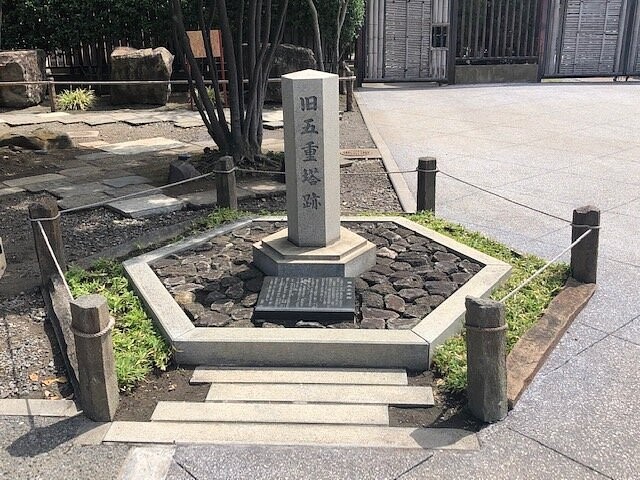
10. The stele of the ancient pagoda
The current pagoda is a reconstruction and according to some, there were two pagodas on the site, one of which had 5 floors and the other 3.
With the devastating fire of the early 17th century, the reconstruction was limited to one of the two, the 5-story one, but it was moved to the lot occupied by the 3-story pagoda.
The original position of the pagoda is remembered by a stele.
11. Nade Botokesan Buddha
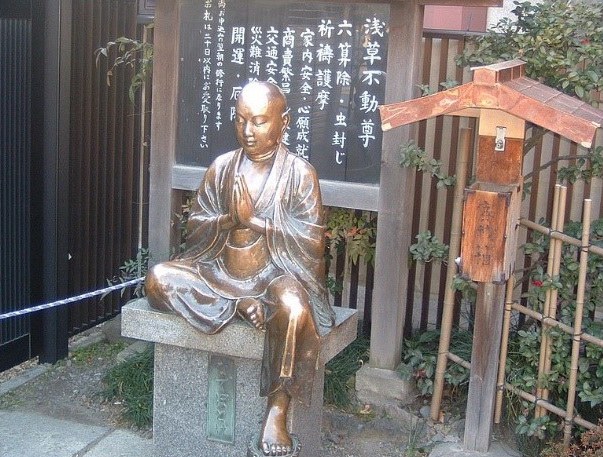
One of the statues at the Senso-ji site is said to have healing properties. The Buddha, close to the pagoda, with his hands folded in prayer, sitting on one leg on a podium has some slightly shinier parts. It is said that if you want to improve your chances of healing, simply rub the healing part of the statue and do the same to yourself.
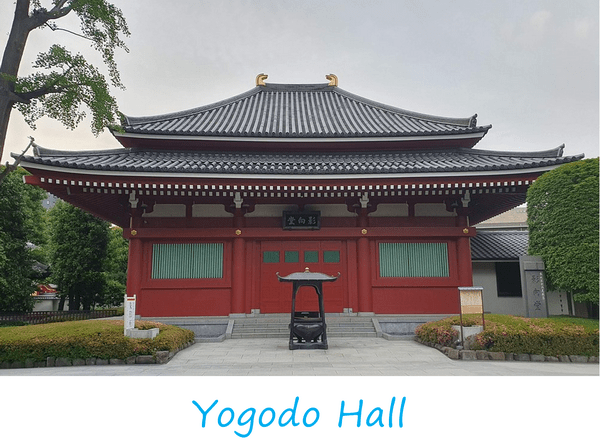
12. Yogodo Hall
Difficult to find information on this room of the Senso-ji temple which was closed when we visited. This construction is relatively recent, 1994, and is in honor of Ennin.
Ennin (Jikaku Daishi) (794-864) was the one who created a replica of the Kannon statue to have an image to show to the public, once a year on December 13. The original bronze version fished by the two brothers is well protected and hidden.
Ennin, a head priest from Enryaku-ji (Tendai School of Buddhism), is said to have created a copy during a visit in the mid-9th century. Ennin’s notoriety, recognized by the imperial family, is the result of an important spiritual journey in Asia. Thanks to the replica he made and which can be presented to the public at some precious and special moments, the site has increased in popularity.
The Yogodo Room aims to highlight Ennin’s initiative and highlights the help he made to the Senso-ji site’s popularity. 1994 was the year Yogodo Hall was built, the 1200th anniversary of the birth of Ennin.
Inside are statues of Bodhisattva Kannon as well as 8 Buddhas, representing the guardians of the 12 signs of the Chinese zodiac:
- Dragon (2000, 2012, 2024) and Snake (2001, 2013, 2025) — Bodhisattva Samantabhadra (Fugen Bodhisattva)
- Horse (2002, 2014, 2026) – Bodhisattva Mahasthamaprata (Seishi Bodhisattva)
- Goat (2003, 2015, 2027) and monkey (2004, 2016, 2028) – Buddha Vairocana (Dainichi Nyorai)
- Rooster (2005, 2017, 2029) — Acalanatha (Fudo Myoo)
- Dog (2006, 2018, 2030) and wild boar (2007, 2019, 2031) — Buddha Amitabha Tathagata (Amida Nyorai)
- Rat (2008, 2020) – Thousand-Handed Guan Yin (Senju Kannon)
- Ox (2009, 2021) and Tiger (2010, 2022) — Bodhisattva Akasagarbha (Kokuzo Bosatsu)
- Rabbit (2011, 2023) — Bodhisattva Manjusri (Manjushri Bodhisattva)
Based on astronomy and the 12-year rotation cycle, each year is associated with a different zodiac sign, but always in the same order.
It is in this sanctuary that you will also obtain one or more stamps of the site (Goshu-in), which confirms your proof of visit.
Next to it, see the small hexagonal temple. It is a rare wooden building that dates back to the 15th or 16th century.
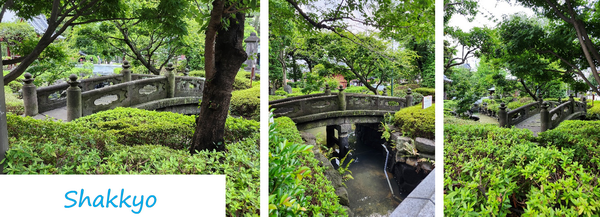
13. Stone Bridge – Shakkyo
There is little to say about the Senso-ji Stone Bridge, except that it is said to be the oldest bridge in the city. No wonder the preserved bridge from 1618 can be admired from a distance. The bridge, with a stream of water still flowing under its arch, has some Koi fish.
Since 1948, this bridge has been considered an important cultural property.
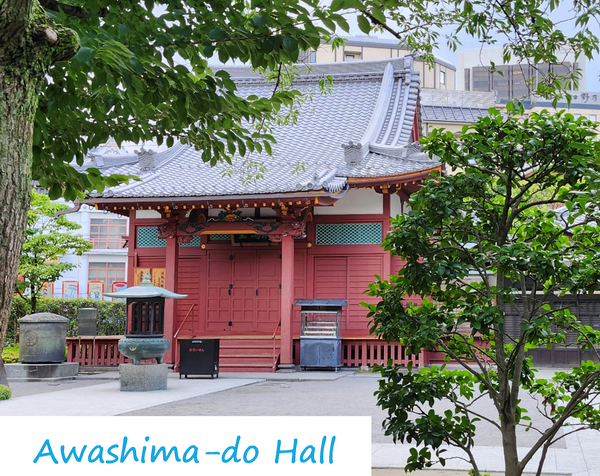
14. Awashimado Hall
Senso-ji Awashimado Hall is one of the satellite halls of the main Awashima Shrine located in Kada, Wakayama Prefecture. The history of the founding of the mother shrine dates back to the 4th century, and according to my understanding, the current hall at Senso-ji site was built between 1688 and 1703 (Genroku period) but was moved and renovated over time.
The Awashima pavilions or sanctuaries all have the particularity of being mainly dedicated to women, their health, their well-being and the strength of the role of motherhood. The main site is known for an annual ritual of prayer for fertility and safe childbirth and the impressive collection of dolls that accumulate over time attracts visitors in Kada.
An annual ritual at the Senso-ji hall takes place on February 8 and is a time to express gratitude for the needles used. These useful tools for working in textiles, knitting, and sewing have reached the end of their useful life. It is time to say goodbye by literally planting the broken or hooked needles into tofu which is in trays in front of the Awashimado Hall of the Senso-ji site. The Shinto religion believes that tools also have a life and deserve to be appreciated.
The deity enshrined at the shrines is Sukuhikona no Mikoto, also called Awashima Myojin based on an island near Kada. This is how the name of the Awashima Hall came about.
Awashima Myojin is the protective deity of women and their physical health and is part of the site at Senso-ji alongside Amitabha who is in the center and Kokuzo Bosatsu (Ākāśagarbha) who is on the right.
It is not clear when the hall was available at the Senso-ji site, however, we do know that Awashimado was spared from the air raids of the Second World War and temporarily served as the main hall of the Senso-ji temple which did not suffer the same fate.
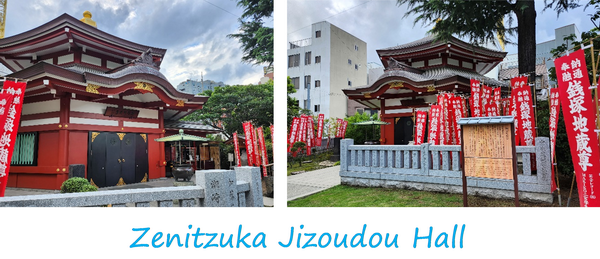
15. Zenitzuka Jizoudou Hall
On the Senso-ji site, there is a small temple where people come to pray for financial prosperity in business, professional promotion or to protect their financial assets.
The story of the site is inspired by one that happened in another city. At the back of a family home, a woman makes the improbable discovery of coins in a box buried in her garden. In order not to bring bad luck to her family, she puts the loot back in its place. The family had a prosperous future and they had a temple built in recognition. This temple still exists in Nishinomiya Town and a branch with a coin from the Edo period can be found in Senso-ji in the Zenitsuka Jizo Hall.
In the temple, there are 6 stone jizo statues. The faithful offer salt, incense or candles to appeal to them and bring wealth to believers.
Zenitzuka translates to “silver mound”.
16. Bentendo Hall
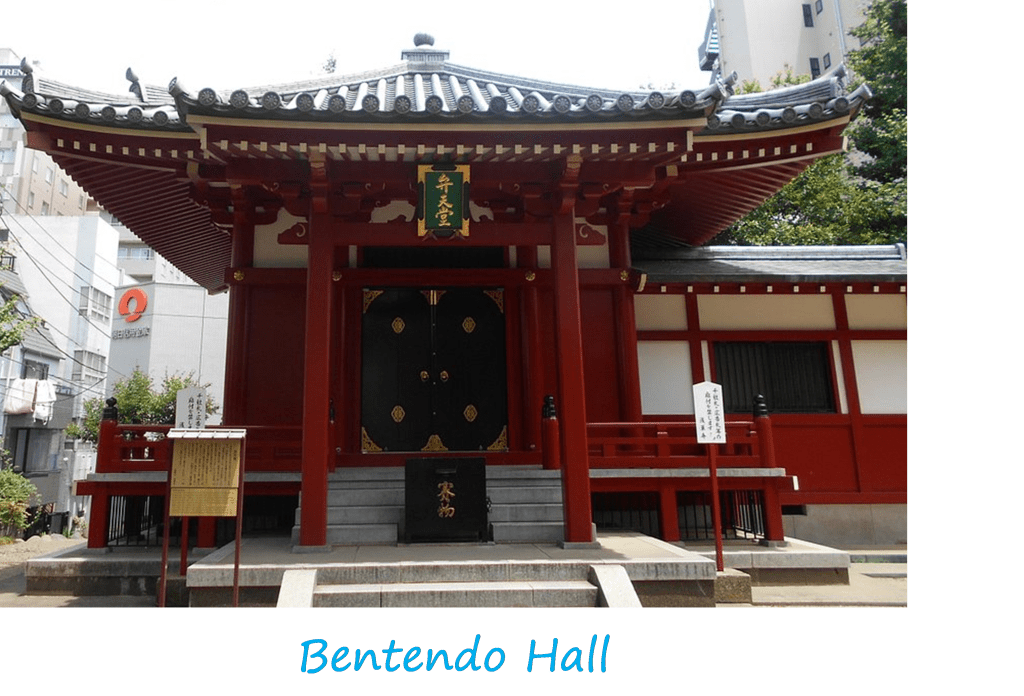
On a small hill, called Bentenyama, next to the famous bell, there is a modest temple rebuilt in 1983 and rarely opened, that of Bentendo Hall.
The temple is dedicated to Rojo Benzaiten. Rojo translates as “elderly woman” and the statue on the site would indeed have white hair, which confirms the mature age of the representation. She is known as one of the seven divinities of fortune and the only female representative of the group.
Not to be confused with Benten-do of Ueno Park. Although both revere Bentaizen, it was modeled a little more like the Japanese model, with very strong powers in finance and less on music.
Bentaizen is said to be closely attached to snakes, which are her incarnation. This temple is only open during the Benzaiten festival which is the day of the snake.
When you are on the site don’t miss the bell (Toki no kane) right next to it. Now it has a more symbolic image, but for a long time, when the city was still Edo, it was used to tell the time to the people of the community. Today it rings every morning at 6 a.m. and announces the arrival of the New Year (Joya no Kane) with 108 knocks. The year 1692 is indicated on the bell.
Although several bells were donated during the war to be used as ammunition, this one was spared for its historical character.
17. Rokkakudo
The Senso-ji site was shaken several times: by fires, earthquakes, and bombing during the Second World War. Miraculously, Rokkakudo survived all these ordeals and is now believed to be the oldest wooden structure on the site and in Tokyo. Although small, this charming one-story hexagonal temple is a rare structural example of construction dating back to 1618, the same year as the stone bridge.
Originally, the temple was built over a well dug. Even though it was moved (in 1994) from its original location, it is granted the title of tangible cultural property.
Devotees go to the temple to pray to Higiri Jizo which supports objectives and visits scheduled on fixed dates.
Note: Rokkakudo translates to hexagon.

18. Hashimoto Yakusi-do Temple
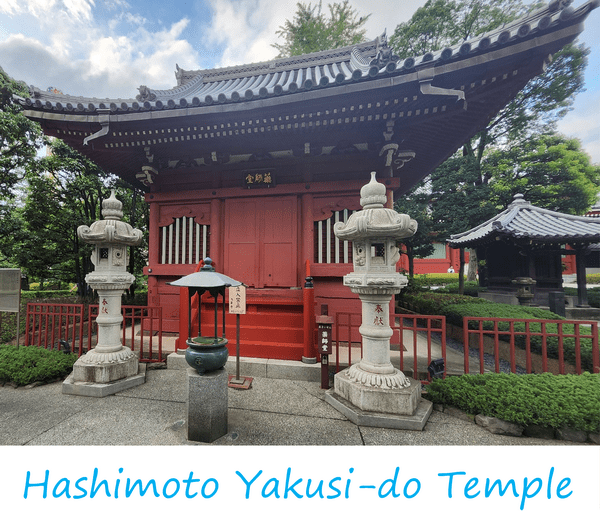
Reconstructed and moved to this location in 1649 by the third shogun, Tokugawa Iemitsu, it is said to be the third oldest building on the Senso-ji site and, like Rokkakudo (1618) and Nitenmon (1642), was spared destruction.
The hall is said to house the seated figure of Yakushi Nyorai, known as the Buddha of Healing and Medicine and is an important figure in Japanese Buddhism. Due to its location, near the bridge, it is called Hashimoto Yakusi-do temple.
Representative of religious architecture from the Edo period, the temple opens its doors on the 8th day of every month.
19. Buddha statues
On the Senso-ji site, there are several statues and monuments which are dedicated donations. Some are camouflaged, others removed from popular passages while others are very visible. Among these, a few caught our attention.
Three (3) statues of Senso-ji are regularly presented together, but here they are separated, because their source is not quite the same although the style is similar. The three are Buddhas seated on a lotus. The period of creation is close together and the three are linked to the spiritual guide to the afterlife.
The Amida-sanzon triad usually includes Amida Buddha at the center and his two assisting bodhisattvas, Kannon and Seish. At the Senso-ji site, Amida Buddha is seen on one side of the main hall alone. Further on, the bodhisatvas Kannon and Seish are next to each other and in the standard order Kannon on the right and Seishi on the left.
- Amitabha Buddha (Amida): The Buddha of Infinite Light (guide to light)
- Avalokitheshvara (Kannon): A bodhisattva with a lotus in one hand (to receive the soul) representing compassion
- Mahasthamaprapta (Seishi): A bodhisattva with hands folded in prayer (for believers) representing wisdom
A community ritual is to have an image of Amida Buddha next to a dying believer to soothe his soul for a departure to the Pure Land, a branch of the Buddhist religion. The golden lotus is intended to receive the soul immediately after death.
Buddha Amida Nyorai
The Buddha is represented here in a seated position on a lotus-shaped base, the shoulders covered with a cloth, the front of the chest bare, with the hands, the palms of which are facing the sky, joined together and resting on the knees in meditation mode. The faithful are led to pray or meditate to Amita so that the latter will come and lead them towards the light when the time comes.
According to the details of the inscription, the statue of Amida Nyorai Buddha was created in 1693 by the founder Imai Tojiro (Edo period) at the request of Sokai Rishoin.

Nisonbutsu / Two Buddhas
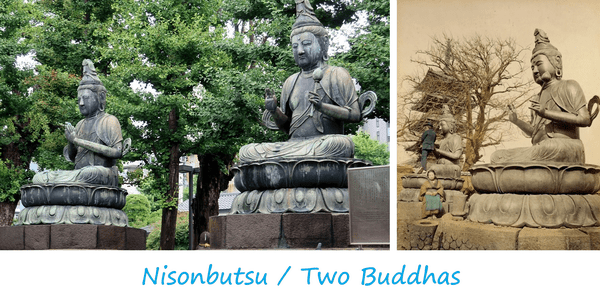
The two bronze Buddhas of Kannon (Bodhisattva Avalokiteshvara (Sanskrit)) on the right and Seishi (Bodhisattva Mahasthamaprapta (Sanskrit)) on the left were donated to the temple by Takase Zenbee in honor of the Narii family. Takase Zenbee had the opportunity to be introduced to the rice business which allowed him to have a prosperous future thanks to Narii Zenzaburo. On the other hand, he learned that the success of his deceased mentor was not as joyous. Takase therefore ordered the two statues, one in memory of the man who inspired his professional life and a second for the prosperity of the latter’s son, Jirosuke.
The statues were ordered from a local founder from the Edo period (1687). For its history, for the craftsman, the statues are classified as cultural property in addition to having miraculously survived the American bombings of 1945.
The two bronze statues are in a seated position on a lotus base. Their shoulders are covered with a veil and their torsos are uncovered. Kannon is holding a lotus in one hand while Seishi has his hands folded in prayer. They are nicknamed wet Buddhas because they are not protected against bad weather or by Amida, often present in a triad.
More about the Zenbee family
It is said that it is a descendant of Takase Zenbee, Takase Jiro, who 300 years later, connected the Senso-ji temple with Isurumuniya in Sri Lanka who donated in 1966 the physical remains of Buddha preserved in the pagoda of Senso-ji.
20. Kinryu Gongen / Kuzuryu Gongen
We rarely see a site called “Gongen” yet here two tiny shrines bear the name “Gongen” which, after research, refers just like “Myojin” to a Japanese deity. Side by side, we find Kinryu Gongen on the left and Kuzuryu Gongen on the right.
Reconstructed after the site was destroyed in 1946, Kinryu Gongen or the Golden Dragon Deity is closely linked to the Senso-ji site and is even part of the site’s official name “Kinryuzan Sensoji”. It represents power and prosperity. One of the four statues at Kaminari-mon Gate is that of the goddess Kinryu. The latter was offered to the temple in 1978 to mark the 1350th anniversary of Kannon surrounding the creation of the site.
A golden dragon dance (Kinryu-no-Mai) was even created in 1958 to celebrate the reconstruction of the main hall. Annually, the dance is performed on the grounds of the site on March 18 and October 18.
Kuzuryu Gongen is considered a more imposing deity and is represented by a nine-headed dragon who fiercely defends the temple against evil. Several Japanese temples are associated with Kyzuryu Gongen, which is linked to rain and bodies of water.
Devotees come to visit the site for the abundance of harvests and fortune.
Do not rely on the smallness of shrines as the equivalent of their power. On the other hand, it can be disappointing not to be able to admire the place when in front of closed doors.

21. Iwako statue
The dedication of Uryu Iwako (1829-1897) was recognized for his extraordinary social work with children, orphans, girls/women, and the poor and earned her a medal of recognition in 1896 and a commemorative statue of her in the Senso-ji site later.
22. Shibaraku Statue
At the back of Senso-ji temple, near a parking lot, there is a statue that represents several authentic elements which, for a foreign visitor, can be difficult to grasp and which is summarized as follows: actor, character, theater, dance and UNESCO.
Firstly, the statue is in the image of Ichikawa Danjūrō IX (1838-1903), an actor who stood out at a crucial moment in the feudal change of Japan when Emperor Meiji opened up to the Western world. Despite the evolution, the actor anchored kabuki in the cultural heritage of the country.
Kabuki is a form of traditional Japanese theater that dates back to the 17th century and which combines performance on stage with flamboyant costumes and masks, in dramatic contexts where dance mixes with episodes of confrontation with swords and samurai. Kabuki is a Japanese art recognized by UNESCO as an intangible cultural heritage of Japan.
A popular theater was located in the vicinity of Senso-ji in the Asakusa district and where Ichikawa Danjūrō IX, in the role of Kamakura Gongoro Kagemasa, was a popular character. With his face painted with red and white stripes, he performed a remarkable entrance, on a platform among the spectators, a signature choreography during a clash between characters and where he performed an energetic monologue from the short tragedy Shibaraku, which earned him significant fame.
The statue is, therefore, an amalgamation of salutations to art and theatrical character.
Like other statues, this one was melted down to create ammunition, but recreated by a successor to the theatrical character in 1986.
23. Chikaraishi
Chikaraishi is a stone that is surprisingly very heavy and which serves as a reference for athletic events or demonstrations of strength. There are several and this monument is far from unique. Several temples hold this type of event, a practice that dates back more than a century. Japanese widely recognize the importance of physical strength in different activities and is necessary in the context of wholesalers selling rice and sake.
24. Tensui-Oke – rain barrel
Several places in Japan have experienced significant fires. Wooden structures were more likely to have major damage. So some religious sites added one or more rain barrels to ease access in case of need. The barrel in front of the main building of Senso-ji is rather a work of art that reminds us of the importance of water in dealing with this destructive natural element. The large barrel structure is symbolic and is topped with six boilers.
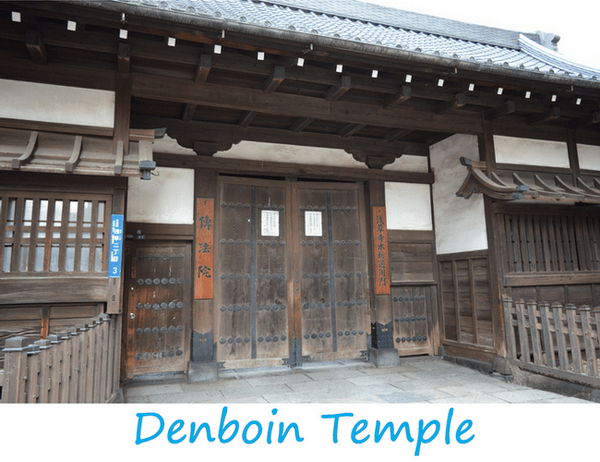
25. Denboin and its Garden
Since it is a private site, that of the abbot of the Senso-ji temple, access is prohibited except for a few days in spring to appreciate the cherry trees which bloom from mid-March to early May, depending on the year.
The large 12,000 m² garden includes 6 main structures, some of which are classified as important cultural properties and some of which date back to 1776. The temple garden was created between 1624 and 1644.
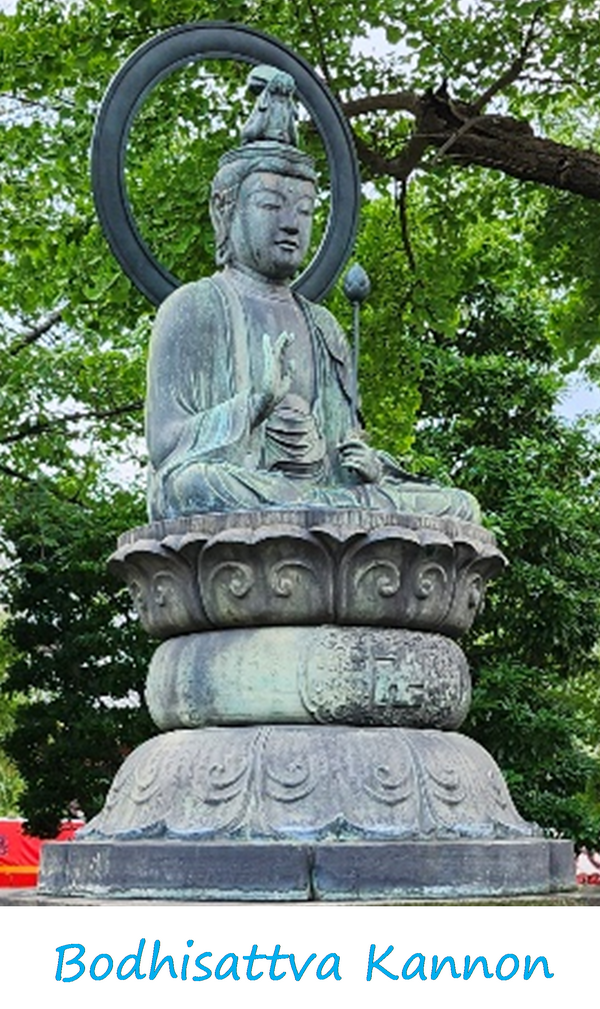
26. Seated bronze statue of Bodhisattva Kannon
We wonder about the real image of the original statue behind the creation of Senso-ji temple. Kannon can be presented in several different figures. Being secretly hidden for a long time, the statue was recovered by the two fishermen in the year 628 and hidden since 645, it becomes difficult to know its real shape and style.
Regardless, we worship Kannon by giving her whatever appearance we deem appropriate. In a seated position, the statue gives us an impression of fullness, calm and control. The flower she holds in her hand is a lotus whose bud is closed like the beginning of a blooming future. With its halo, we can envision that this statue is linked by a divine shutter. Although not recognized in Buddhism, the halo reminds me of angels in other religions with roles as messengers, protectors, spirit guides and more.
The copper statue, approximately 1.7 meters high, was made in 1720 at the request of the monk, Kozan Gido, thanks to the generosity of many donors whose names were engraved on the base of the statue.
In addition, the creator of the piece, Konuma Nagamasa, is part of the history of foundry artisans of the Edo period.
It was added to the register of cultural properties of Taito City in 2007.
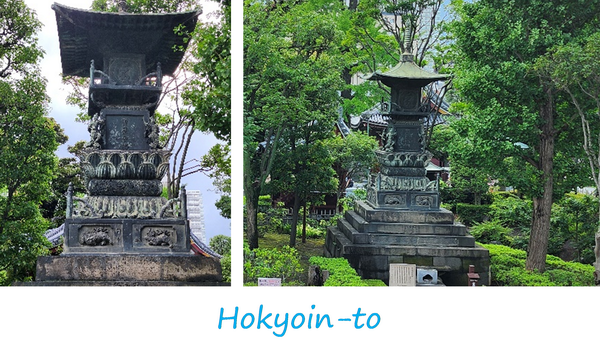
27. Bronze Hokyoin-to
The Senso-ji site is full of historical elements precious to Japanese culture, including this one. Hokyoin-to at the Senso-ji site is a bronze pagoda originally built in 1761 by Nishimura Izuminokami, a local foundryman. The latter was able to preserve beautiful details of the work commissioned by 16 rice brokers and moneylenders from Kuramae.
Despite damage caused by the 1865 earthquake, the pagoda was restored in 1907 in commemoration of the Russia-Japan victory and demonstrates casting qualities that date back to the Edo period.
This bronze Hokyoin-to is one of the important cultural properties of Taito.
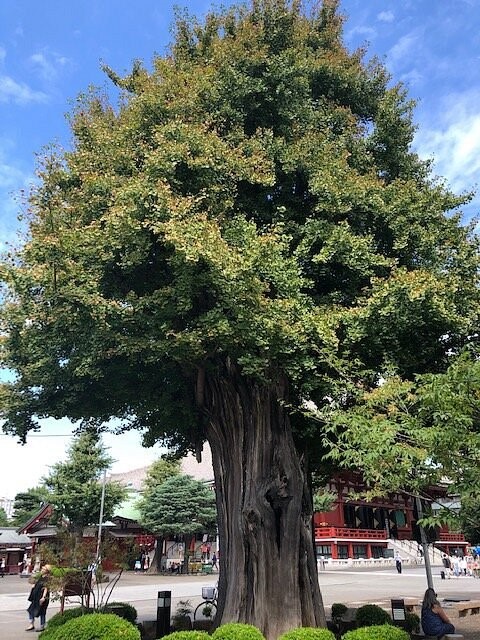
28. The tree of rebirth
On the temple grounds, despite significant injuries caused by the bombings of 1945, a tree miraculously grew back. A symbol of hope to recover from serious losses.
Even before its great injury, the tree had historical recognition.
For all my posts on Tokyo, click here.
 Simple Travel and Recreation