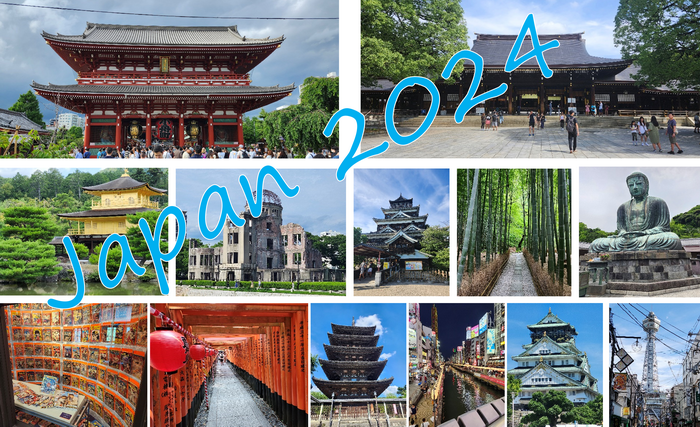
I had the chance to travel to Japan in the summer of 2024 and I was pleasantly surprised on several points.
In two weeks, we visited:
- Tokyo
- Kamakura
- Kyoto
- Hiroshima
- Osaka
The cities are populated without being uncomfortable. People seemed perfect to me, a perfection which, I hope, is not unhealthy. They seemed to me to be impeccable in the sense of respect for others, respect of their surroundings, polite, courteous, well dressed, clothes without bad creases, hair without flyaway, no regrowth, no baldness and no white hair other than at an advanced age. You will see very few Japanese women wearing camisoles, spaghetti straps, navel sweaters, shorts, leggings, or pants showing underwear. The majority of faces appear pore less and perfectly smooth. On a business day, the majority wear (clothing and makeup) sober, natural color without a distinguished style. Even in hot weather, they keep their sleeves long. Wearing gloves is common, as are using parasols. Free umbrella loans are common and parasols can be attached to bicycles.
In hotel rooms and in some temples, you are asked to remove your shoes. Wearing stockings is common even with sandals.
The kimono brings a little cheerfulness with floral prints and is worn on any day.
Couples show few signs of affection in public and holding hands is rare.
Even with a 14 million population in Tokyo there is no waste in the streets. To drink or to eat, you stop at the designated places which include next to a vending machine and smoking in the streets is discouraged. Head towards the designated sections, keep your voice low and people are asked to turn off their phone ringers on public transport. People don’t talk on their phones in public places. The cars even seem to be less noisy. This approach makes it possible to share common places in complete civility.
Despite the large population, we noticed that personal space is respected and it is not uncommon for Japanese people to doze off on the train, subway or bus.
We cross the street at the planned intersections and wait for the signal. We queue, no rush, no running.
The restaurants are small. You sit down, you order, you eat, and you leave. Cafes allow more of a break. You will find Starbucks almost everywhere, even in public parks. We drink our coffee on-site and not while wandering the streets or parks. Please do not blow your nose at the table, head to the toilets. Tea is served like water.
Everyone eats with chopsticks. No tipping. This is not part of Japanese customs and can be considered insulting if you dare.
If you choose to eat or take a break on a tatami, bring your legs towards you, avoid extending your legs or showing them under your feet to others, and sit on your feet.
Please note that some restaurants accept smokers. If this bothers you, find out before sitting. Also, sometimes you will have to pay the bill in cash, even if you see an indication on the door confirming that you can pay with a card.
We eat mainly vegetarian dishes except for occasional fish, and we had some difficulties. Dishes served in restaurants are often accompanied by animal protein and rice or pasta (soba or udon). Fried foods are common, but salads or even tofu are surprisingly unavailable. Although Japan is famous for its cuisine, we were disappointed at times. On the other hand, the sushi is excellent. We found a vegetarian restaurant guide, but only on our last day.
Need a snack? Family Mart, 7-Eleven and Lawson are options even for prepared meals.
Now comes the subject of language. I would have loved to talk to them, but the language barrier is really important. Few people speak English fluently. Large museums have information in English, but sometimes the descriptions are limited. Translation with certain applications is not always representative.
Know that I have already tried to learn a foreign language. It’s good to say “hello” but when you don’t understand the answer, it’s disappointing. Google translate “Lens” is not yet sophisticated enough to translate from Japanese to English.
The security aspect is quite impressive but still there are cars reserved for women at certain times of the day. Bicycles are left without locks in front of businesses or the bar and children go to school without a parent. There are no beggars, very few street entertainers, and few homeless people in tourist neighborhoods.
Despite our deep desire to capture images of all the sites we visited, some sites, temples, palaces, and museums restrict photos. We respected the instructions when indicated which also included speaking in a low voice, not eating on public transport and washing hands when arriving at a spiritual site.
Cars drive on the left and naturally, unless otherwise indicated, you stay on the left on sidewalks or when going up stairs.
There are public baths, but I didn’t try them. You may be refused access if you have tattoos. You must wash and rinse yourself thoroughly from head to toe before entering the baths. Most are without bathing suits.
Even museum toilets have heated seats with bidets and background sound that can be activate to cover up noises.
Opening hours for museums, parks, temples and palaces vary, often closed on Mondays in Tokyo and Wednesdays in Osaka. If a public holiday falls on a Monday, that day they may be open, but the next day they will be closed. Do not rely on Google for information as the information may be incorrect. Personal experience.
You will find places of worship associated with Shintoism and Buddhism, the two main religions of the country where temples and shrines welcome their members during their opening hours. There does not seem to be any time for communal prayer. The population gathers at the time that suits them, which avoids crowds. It is then appropriate to respect the routine of the local people who come.
There are many places of worship. It is difficult to choose which ones to visit. You should know that the concept is relatively similar. Some have incredible features while others are more sober.
Depending on your preferred experience, it might be better to visit a temple or shrine on one day more than another, as there are certain days to worship one deity more than another. During this day, the site is busier.
There is little public art and I noticed that few annual flowers are added in summer. However, the manhole can be meaningful and colorful.
Some cultural elements that you might have the chance to observe include visiting a museum dedicated to manga, seeing samurai in a museum, contemplating a Japanese garden, hearing the drums, tasting sake, savoring sushi, seeing even from afar, Mount Fuji, attend a sumo wrestling tournament, practice origami, meet a geisha, attend a Japanese play, sing in a Karaoke, enter an electronic store or gadgets and taste the different kinds of KitKat. But one thing is certain if this is not done, you must master the chopsticks.
A few important cities have undergone great upheaval, despite a past rich in history. The great fires and bombings forced an architecture influenced by modernism.
If you see a chrysanthemum with 16 petals, it is the imperial coat of arms of Japan. The Japanese monarchy dates back hundreds of years BC. If you visit a palace you will notice the simplicity of the sites especially when compared to those of large European cities.
Our July 2024 Japan itinerary
- Day 0 (12) – arrival
- Day 1 (13) – Tokyo
- Day 2 (14) – Tokyo
- Day 3 (15) – Tokyo – Kamakura
- Day 4 (16) – Tokyo
- Day 5 (17) – Tokyo – Kyoto
- Day 6 (18) – Kyoto
- Day 7 (19) – Kyoto
- Day 8 (20) – Hiroshima
- Day 9 (21) – Kyoto
- Day 10 (22) – Kyoto – Osaka
- Day 11 (23) – Osaka
- Day 12 (24) – Osaka – Tokyo
- Day 13 (25) – Tokyo (1/2 day) – departure
Enjoy your visit, if you select to go.
 Simple Travel and Recreation