
Taito
If it’s not already on your list of places to visit, Ueno Park should be on it. While it’s easy to spend hours in the park, depending on your interests, the time you have, the weather on the day, and whether you’re traveling alone or with family, you have plenty of opportunities here. You can enjoy nature, culture, and history all in one place, and one thing is for sure, don’t let a few drops of rain stop you.
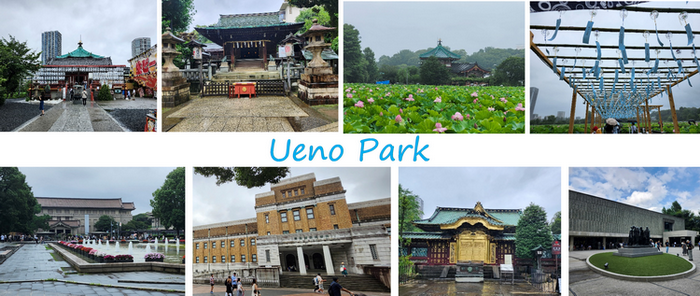
A public park since 1873, you will find trees in bloom in spring, temples, shrines, a zoo, museums, statues, ponds, fountains, mobile kiosks and a Starbucks. Although access to the park is free, museums are not. The route is relatively flat and you are a 2-minute walk from Ueno Station.
History
Ueno Park is located on the site of a former large temple that housed several important buildings. Known as Ken’eiji, it was heavily destroyed during major battles including the Boshin War of 1868. Following the destruction, the large area was converted into a public park in 1873 and a few smaller temples are now scattered around the site. Very few architectural elements have survived. The 5-story pagoda is a good example. Also, Kiyomizu Kannondo temple, and a gate as well as the Toshogu Shrine were saved.
Statues
If you walk around the park, you will notice a few statues installed here and there, but with little information. However, they are famous figures in Japanese history.
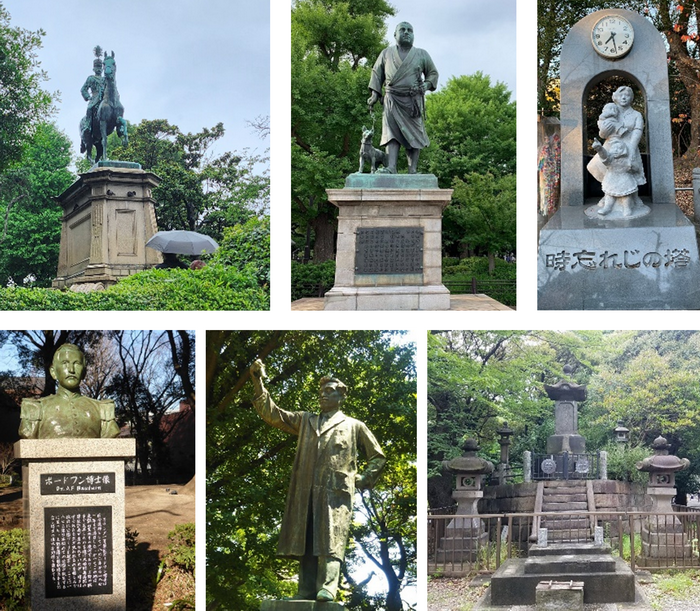
Saigo Takamori (1828-1877) with his dog: The one who brought Emperor Meiji to power to abolish the feudal system, is also the one who left the ranks in opposition to modernization and the emperor’s strong interest in the West. His presence in the ranks of the aristocracy allowed him to create internal connections with the most influential. His departure had a domino effect on others who imitated him.
His dedication to his beliefs, despite opposing the imperial ones, earned him recognition from the people. The man with the unusual build of the time, Saigo Takamori, is the one who led a troop of tens of thousands of soldiers but committed suicide when his last attempt failed.
Despite his opposition, the last samurai was pardoned by the Meiji government after his death.
Anthonius Franciscus Bauduin (1820-1885): Despite the need for a hospital, the Dutch-born medical professor and military doctor who settled in Japan promoted the creation of Ueno Public Park.
Hideyo Noguchi (1876-1928): A physician and bacteriologist, he made important advances in syphilis. His importance is such that he appears on the Japanese ¥1000 bills.
Prince Komatsu Akihito (1846-1903): The statue of the prince is the one where he is seen on the back of a horse. Prince Komatsu Akihito, a former officer of the imperial army, represented Emperor Meiji in various European diplomatic events.
The Memorial Tower (Toki Wasureji no Tos) is a more recent work, from 2005, where we can see a clock and a mother with her children. This work commemorates the victims of the Second World War. The author of the sculpture, Kayoko Ebina, was closely affected by the tragic events.
Tomb of the Shogi-tai warriors This monument is a tribute and tomb dedicated to the veterans of the Shogi-tai infantry. The Shogitai group, established in 1868, was a group of elite samurai who expressed their discontent with the new Meiji imperial government by being ardent defenders of the last shogun.
The Battle of Ueno in 1868, part of the Boshin War, resulted in the death of the majority of the Shogitai warriors. This event took place on the current site of Ueno Park when it was the Kan-eiji Temple.
The large tombstone, built by one of the few survivors, was added to the smaller one provided by a priest of the Kan-eigi Temple in 1869.
For these elements, the site is recognized for its cultural significance.
Nature
This large green public space allows you to take the time to sit under a tree. Ueno Park is a place where thousands of people will meet during the cherry blossom season, from late March to early April. There are more than 1000 cherry trees for a high flowering show.
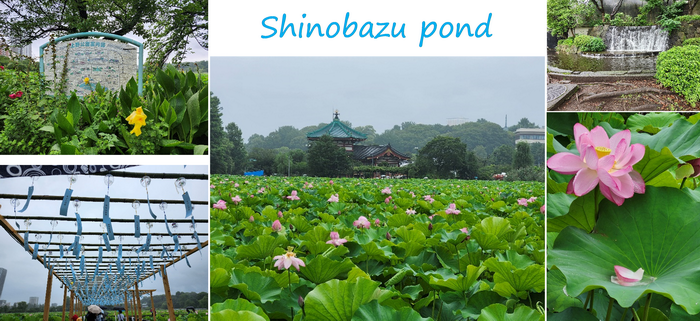
If you are there during the summer, the Shinobazu pond is a must-see. We were amazed by the lotus pond and the wind chimes, even on a slightly rainy day. It was a magical moment of incomparable serenity under the sound of the tickling of the bells in the wind.
In addition to the zoo where more than fifty species live side by side, it is possible to come across crows or even snakes.
If you are like me, you will appreciate the water fountains.
Shinobazu pond
The Shinobazu pond is divided into three parts, each with its particularity.
The large Shinobazu pond has long had its island. It is on this island that we find the Benten temple, dedicated to the goddess of music, but the island was finally joined to the shore by a bridge in order to facilitate access. The lotus pond is really pretty and the walk to the sweet sound of the wind bells was for me a memorable moment of the trip.
Two other ponds are nearby, one of which allows you to rent small watercraft to navigate on the body of water and another is the Cormorant pond where it is said to be popular with the birds.
Ueno Zoo
Like many big cities, Tokyo has its zoo and the oldest in Japan is here in Ueno Park and was established in 1882.
Following the threat of war, to prevent the most dangerous species from escaping from the zoo, the country made the difficult decision to kill several that could have had disastrous results on the population. This decision was highly contested, but the relocation options were too long to execute.
Long integrated into the National History Museum, the zoo is now a destination in itself.
There are several species, 2600 animals of nearly 500 species, which come from all around the world. The stars of this zoo are the pandas and the gorillas. However, you have to expect long lineups to see the pandas.
Temples and Shrines
On the site of a large temple, there are now several small shrines and places of worship.
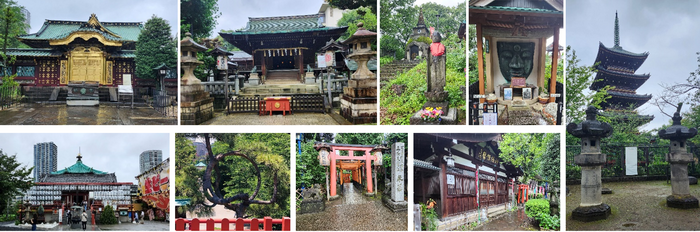
A shrine with Edo period architecture is recognized as a national treasure and was built in 1627 in memory of Tokugawa Ieyasu. The beauty of the site lies in the detail of gilding, a collection of stone and copper lanterns, the Sukibei wall, with animal engravings, which surrounds the shrine, and the large stone Torii gate that has survived the great tremors.
Benten-do
There are many reasons to be intrigued by this site, its location, its colors, its strengths and its history. You will find the red, green and white Benten-do Temple on a small island in Shinbazu Pond. To access it, a land access has been added over time. The site includes the temple, commemorative and honorary stones, lanterns, sculptures and amulets.
Although this temple is Buddhist, the name Benten is a diminutive of Benzaiten, a Japanese goddess worshiped in Buddhist and Shinto cultures. Her virtues are those of good fortune, knowledge and being the patron saint of music. You will notice that monuments are linked to the goddess’s distinctive musical instrument, the biwa (four-stringed lute) on the site. Even amulets from the site are available in the shape of this instrument.
As you walk up to the temple, you can smell the scent of incense, and you will be greeted by an Ugaijin at the bottom of the steps. This is a statue of a coiled white snake with the head of a bearded man that regularly accompanies the goddess Benzaiten and is worshipped for crops and fertility.
Lanterns protect the temple where prayers are inscribed. Various stones on the site are offerings to the goddess for wishes to be granted.
Ueno Daibutsu
It was at the sound of the bell that we discovered the face of the Great Buddha right next to a small but cute pagoda. On the site itself, there used to be a huge seated bronze Buddha. Built in 1631, the 6 m high Great Buddha experienced great shocks, after the terrible earthquake of 1923 and because of the need for metals for wars, only the face remains.
More information on this site here
Kiyomizu Kannon Temple
Built in 1632, this was a small temple among the 68 structures in the larger Kan’eiji complex that formed the present public park. Having survived wars, it was moved to its current location in 1694. The site is popular for a curved tree in the temple’s back yard that is nicknamed the “Moon Pine” and provides an unusual setting for the view from the terrace.
The temple is associated with fertility and conception. Thus, future parents come to pray for the birth of a loved one, their health and protection.
The series of Torii gates painted in a vermilion orange attracts us and leads us to a site that is not grandiose, but its power seems to bring good luck to many. A few steps go down to the shrine, which is out of the ordinary.
A fenced passage is limited to the faithful. We respected this warning and were content to admire the more general part. However, a statue of Inari is said to be nestled in one of the rooms. It is known that Inari is associated with white foxes, which explains the omnipresence of fox statues on the site.
People come here to pray for abundance and success in harvests, commercial or financial, as well as for fertility and matrimonial union.
Note the chozubachi (stone basin) used for Temizu (a purification ritual before entering a sacred site) rests on four demonic faces at the four corners of the basin.
The enclosed site is shared with the Gojoten Shrine.
Gojoten Shrine
The small Shinto shrine is known by various names: Gojo-Tenjin Shrine, Gojo Tenjinja, Gojoten-jinja Shrine.
Two words to describe Gojoten Shrine: health and education. Worshippers come here to pray for healing, good health, the recovery of a sick person, or academic success.
A beautiful and unique architectural element to notice is the chozuya, the purification pool, in the shape of a lotus and the phoenix sitting on the square roof and whose eight pillars are octagonal. The number 8 is said to have special powers.
Cultural
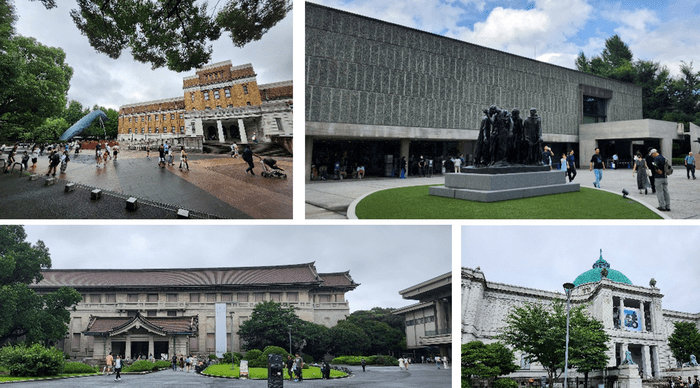
On the Ueno Park site, you will find a variety of museums including:
- the Tokyo National Museum – Japanese art
- the Tokyo Metropolitan Art Museum for evolving and more contemporary collections
- the National Museum of Western Art to discover mainly European art
- the National Museum of Nature and Science to discover the evolution of humans and science, see different stuffed wildlife species that surround us more closely or to learn more about the innovations that serve us in our daily lives.
Don’t be fooled by appearances. Despite their proximity, it is difficult to do them all in one day. A choice is necessary or plan several days to visit. I have already indicated that the Ueno Zoo is also relatively popular.
Tokyo National Museum
You are on the largest and oldest site for the conservation, protection and exhibition of Japanese and Asian art. The Tokyo National Museum dates back to 1872: a period during which Japan opened up more and more to the Western world, we are then during the Meiji reign. Japan participated in universal exhibitions and had a place to manage the treasures representing local culture.
Over time, the Tokyo National Museum (NMT) acquired works that went beyond Japanese territory and included riches from Asia. Thus, you will see, in different forms, paintings, sculptures, calligraphy, jewelry, pottery, swords and armor. You will find an impressive collection of objects from several generations.
The museum includes 6 buildings as well as a garden with water features. Some rooms are not open to the public daily.
- Honkan: The large hall is just in front of the main entrance. The concrete construction with a tiled roof dates back to 1938 and is an imperial Teikan style. This is where you will find the Japanese art gallery which is spread over two floors.
- Toyokan: In this 1968 building, you will find works of art from Asia.
- Heiseikan: This is the most recent construction on the site, built in 1999.
- Hyokeikan focuses on temporary exhibitions. The building has a more Western look and was inaugurated in 1909.
- Horyuji treasures: also inaugurated in 1999, the gallery is a little hidden behind Hyokeikan, but the detour will be worth seeing the gifts of the Horyuji temple of Nara to the imperial family in 1878.
- Kuroda memorial hall: This pavilion is outside the limits of the museum, but has been integrated among the buildings. The building was built in 1928 following the last wishes of the Western-style painter Kuroda Seiki. According to the Tokyo National Museum website, admission is free.
National Museum of Nature and Science
To be honest, we chose to not visit this museum for several reasons, the main one being that we visited 3 similar museums in the past year and since we spent more time in the Tokyo National Museum, it was unlikely that we would stay less than two hours. However, be aware that everyone should, at some point, visit a nature museum and a science museum.
According to the images shared, you’re in for a good time here and you’re likely to be amazed by the life-size animals, large insect displays or the dinosaurs’ skeletons. This is where you can see the real fur of Hachiko, Shibuya’s famous loyal dog. A statue of the dog can be found at Shibuya Scramble Crossing.
For the science and technology section, several museums of this type allow us to better understand the evolution of science over time, technology or transport developments which have had a significant impact on our daily lives.
Seeing the huge whale displayed vertically outside and the train, it is certain that this site shows large-scale subjects.
Under one roof you will have access to a lot of information that covers both nature and the technological aspects that are often managed separately. The museum is intended for an audience of all ages, even adults.
Plan more than two hours for sure.
National Western Art Museum
In Ueno Park, you will find several museums including the “National Museum of Western Art”. This museum is said to be the only Japanese site that presents a collection exclusively related to Western art and focuses heavily on European works.
Having visited major museums recently in London as well as the MET in New York, we have rather focused our time on museums that presented local art.
That being said, we still took a few minutes to admire the building classified as a world heritage site in 2016 for the work of “Le Corbusier”, the architect of the 1959 construction. The starting pillar of the museum is the personal collection of Matsukata Kojiro which includes paintings by impressionists and sculptures by Rodin. Some of these can be admired outside the pavilion and include Rodin’s Thinker, Rodin’s The Kiss and The Gates of Hell also by Rodin. Over the years, the museum has accumulated other works making it a rich place for works of art.
You can see works by Monet, Manet, Picasso, Renoir, Rodin, Van Gogh, Gauguin.
Ueno Royal Museum
The Ueno Royal Museum has been presenting temporary art exhibitions since 1972, from private collections that invite discussion. July 2024 – temporarily closed.
Tokyo Metropolitan Art Museum
In Ueno Park, one of the museums is the Tokyo Metropolitan Art Museum whose permanent collection is limited to 12 pieces of sculptures from the 1970s-80s and 36 works of Japanese calligraphy.
This art museum established in 1926 is housed in a 1975 structure and can easily go overlooked, as the temporary collection is continually renewed. Our current impressions of today may, therefore, no longer be applicable next month. It’s up to you and the time and interest you have. Know that the exhibitions are not limited to local art.
Amphitheatre
Near the pond, is an outdoor amphitheater that can accommodate hundreds of guests for various events. When we passed by, we could hear a group of young singers practicing for an upcoming show.
For all my posts on Tokyo click here.
 Simple Travel and Recreation