
Shinjuku / Shibuya
Shinjuku Gyoen National Garden is quite a contrast to the bustling Shinjuku district. It’s quiet and relaxing, but not impressive. It’s here that I realized that the Japanese garden model I’ve visited elsewhere in the world, including the one at the Montreal Botanical Garden, are representative, and consequently reduced the wow factor once here.
You need to pay to access this park and the opening hours vary according to the seasons. We were there late in the morning on a hot summer day. Little traffic, lots of greenery and little color other than in the greenhouse.
Not to be confused with a park, the garden is a place where consuming alcohol, smoking and using games are prohibited. Unless you are under 12 years old in the reserved area and even then, restrictions apply.
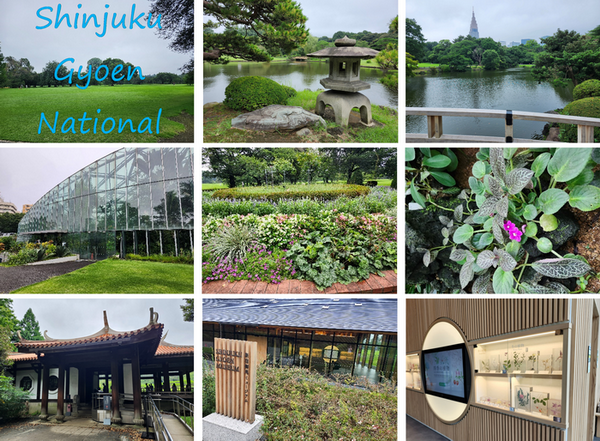
We walked around the site at a pace that seemed appropriate to us, not making any unnecessary detours given the simple nature of the site. We saw the greenhouse, the Shinjuku Gyoen Museum, the round flowerbed, the Landscape Garden, the Tulip Tree, the Taiwan Pavilion, the Japanese Garden, and the Upper Pond.
The greenhouse and the Japanese garden are the most pleasant spaces of the site in my opinion, but without being a reason to make this site a necessary detour. The greenhouse presents a beautiful variety of tropical plants.
The history of this vast area dates back to the Edo period (1591) when a private mansion belonging to a high-ranking official was located there. In 1872 (Meiji era), the government established an agricultural station, the remains of which can be seen right next to the greenhouse. In 1906, the site became an imperial garden with privileged guests allowed access, and in 1949, after the war and major damages from the bombing, the site was converted to a national public garden.
Among the original sites, a former Imperial Rest house (nationally designated important cultural property) located near the greenhouse is currently under renovation (July 2024) and the Taiwan pavilion was miraculously spared from aerial destruction.
Due to its history, the garden remains associated with the Japanese monarchy, Emperor Hirohito (posthumously honored Emperor Showa) (1901-1989) even chose this garden, a reminder of his childhood, as the official ceremony location for his funeral which took place in February 1989.For maps of the site by season:
https://www.env.go.jp/garden/shinjukugyoen/english/2_guide/map.html
The garden is divided into four:
- Landscape Garden
- Formal Garden
- Japanese Traditional Garden
- Mother and Child Woods
Note: It is mentioned in the guidebooks that this is a great place to see cherry blossoms.
There are three entrances to the garden: Shinjuku Gate, Okido Gate, and Sendagaya Gate. If you are arriving via Shinjuku-gyoemmae station, take Exit 2. It is a 5-minute walk from there.
For all my posts on Tokyo, click here.
 Simple Travel and Recreation