
Shibuya / Shinjuku
Unknowingly, the first shrine we visited is one that has great Japanese historical importance, represents the oldest local religion, is located in a serene place and highlights the appreciation of a people for their emperor.
This Shinto shrine, built in 1920, is dedicated to the 122nd Japanese Emperor Meiji (1852-1912) and his wife Empress Shoken (1849-1914). The emperor reigned from 1867 to 1912 and his reign was marked by a global opening by tinting Japanese culture with Western dash without distorting it. The shrine is therefore a mark of recognition from the people towards the couple known for their solidity, harmony, avant-gardism and contribution to today’s Japan.
Shintoism originated in Japan. In addition to being the oldest religious, spiritual and philosophical belief in the country, it advocates polytheism, that is to say the belief in several divinities each having their power or element of influence. On the Meiji Jingu site, the matrimonial aspect is put forward with the symbolic imperial couple. Even if it is not the resting place of the couple, the latter being in Fushimi-momoyama, south of Kyoto, the Meiji Jingu shrine glorifies the spirits of the emperor and empress and venerates matrimonial harmony. Several marriages are celebrated there and the two trees tied by a rope on the site which reinforces the attachment.
Like other Shinto shrines, there is no section inside a facility. Prayer is often done outside by removing our shoes and going to the threshold of the opening and following a simple ritual to venerate the spirits.
The area on which the shrine was built was not chosen at random. The emperor and his wife regularly visited the place. The “inner garden” (most pay to access) comprises the facilities that the emperor and empress cherished. The inner garden includes an impressive collection of varieties of irises (over a thousand plants of 150 species) in bloom towards the end of May, a tea room and the Kiyomasa well. Recently, the latter has been used to grant wishes, which creates queues to access it. The well is said to have been dug by Kato Kiyomasa, a military man of the Edo period who is said to have had a second home on the premises, and its water is said to be naturally maintained at a temperature of 15C (59F) with the flow of 60 liters of water per minute. Although not drinkable, the spring water is said to be of excellent quality and feeds the southern pond.
Meiji Jingu Shrine is open daily and opening hours vary depending on sunrise and sunset. Given the effects of time difference, we visited early enough to beat the peak hours of tourists and Japanese alike.
Located in a green haven, one of the largest green spaces in Tokyo, and surrounded by mature trees from several regions of Japan, the path to the temple is dotted with elements that are both typical of Shinto temples and also includes unique subjects. The iris garden and the well of the inner garden are some of them, but we can also add the style of the Torii, the barrels of French wines, the museum, the recognition of the people for Emperor Meiji, the association with the love and matrimonial aspect which are exceptional aspects of this temple.
The site is accessible via 3 entry points that take you via well-maintained walking trails to the sacred place. The accesses are marked by enormous wooden Torii gates and once crossed the forest around you will soften the sound of the city. The heart of the sanctuary is about ten minutes of easy walking from the park entrance.
The three (3) entrances to the site are the Sangubashi Entrance (near Shangubasi Station), the Yoyogi Entrance (which is not next to the park of the same name, but is the closest to Tokyo Metro Kita-sando Station) and the Harajuku Entrance (near the station of the same name).
There are several Toriii gates on the site, one at each of the entrances to the sacred place and a second series as you approach the main shrine. Those of Meiji-jingu have the particularity of being 12 meters high and made of wood that has retained its natural color. Note the double curved lintels with the three chrysanthemums with sixteen petals, an imperial symbol that you will notice throughout your visit to Japan.
It is customary to bow slightly, out of respect, when passing under a torii, both on arrival and departure. When possible, do not pass under the torii, but on the side.
Entrance to sacred Japanese places includes purification (Temizu). You will find a fountain (Temizusha) whose water is constantly renewed to wash your hands and mouth. It’s simple. Use the ladle by taking it from your left hand to rinse your right hand, transfer it from hand to now wash your left hand. Take water in the palm of your left hand and rinse your mouth. Do not swallow the water, but empty it to the side and not into the main basin. Hold the ladle vertically to clean the handle. Wash your hand again.
Do not throw coins into these areas.
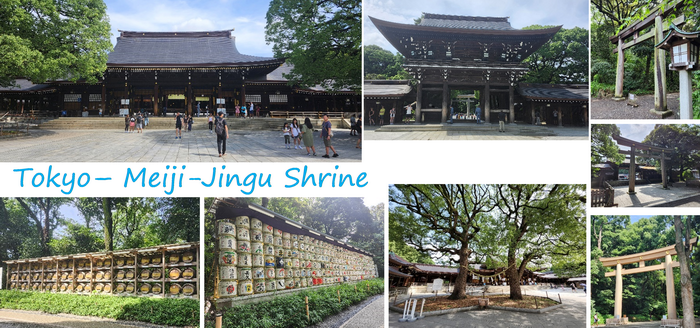
The heart of the shrine is defined by the Minami Shinmon, which serves as the main entrance and is one of the few original structures of the shrine to have survived the attacks of World War II. The two-story structure with its Japanese curves and imposing wooden doors invites you to enter the grounds. The white accents embellish and soften the dark color of the cypress. Be sure to step over the wooden beam of the gate and not step on the threshold. Bowing your head is a sign of respect. It is very likely that when you pass, the doors will be open, but notice the appliqués and patterns on the doors. See the little hearts in the ornamental ironwork.
Once you pass through the Minami Shinmon you will notice that the structure is part of an architectural ensemble surrounding the stone-floored compound that is opposite the main building.
The buildings in the main part include the main hall (honden), the prayer recitation hall (noritoden), the inner shrine hall (naihaiden), the outer prayer hall (gehaiden), the amulet counter (juyosho), the treasure house (shinko), the offering kitchen (shinsenjo), and the Shinto music and dance hall (Kaguraden). Some parts are only accessible to participants.
Before entering the main hall, two sections on either side of the main sanctuary are surrounded by majestic large trees, camphor trees.
On the left side, what at first glance appears to be a single tree is in fact two trunks whose foliage joins at the top. They are called “Meoto-kusu”, married couple and they are even tied by a rope. The divine trees are associated with good husband and wife relations as projected by Emperor Meiji and his wife. Despite the great fires, the trees have survived.
On the right side, under another camphor tree, is the Ema-kake, or wish display. In fact, you will notice that in most Shinto Shrines, it is possible to write your wishes on different styles of medium. Ema are small thin wooden boards where you can, at a low cost, write your wishes and dedicate them to the temple so that they come true.
You will arrive at the main shrine where you can meditate for a few minutes. The ritual is simple. Start by making an offering in the designated section. If there is a bell on the premises, ring it two or three times, then bow twice, clap your hands twice and bow again, this time at 90 degrees. Make your wishes.
Photographs of the interior of the main shrine are prohibited. The style is relatively simple, reflecting Japanese Shinto culture without frills or exuberant wealth. The focus is on the human, spiritual and non-materialistic aspect.
At the fortune counter (juyosho), in addition to the amulets (omamori) that many buy for wishes related to road safety, health and academic success, the site is known for its special amulets for love (sowa mamori) that are infused with the aroma of camphor trees. The amulets are placed in a bag and must not be opened until their function takes place.
For some, the religious site may seem less spectacular, but by understanding the depth of Shintoism, which is not tied to one or more specific people, one understands the meaning better.
On the passage leading to the main site, near the south entrance, an impressive, colorful and ornate collection of sake barrels “kazaridaru” were donated by local producers as offerings to the deities.
On the other side of the passage, a collection of oak wine barrels, but this time from France. Surprising! Emperor Meiji was a good wine lover and as a recognition of the two countries’ friendship, France provided the barrels to the site. Please note that none of them contain alcohol.
The northern side of the temple grounds is less attractive, but at the northern pond is the stone turtle (Kameishi) which is said to make you happy if you touch it. Towards the northern exits is also the Shiseikan Dojo which is a training hall where traditional Japanese Budo (Judo, Kendo, Aikido and Kyudo (Japanese archery) are taught. Also, the treasure museum is located there but seems to have been closed since the Meiji-jingu museum opened.
If you want to visit a museum, the brand new Meiji-jingu museum opened in 2019 and displays a variety of the emperor’s personal effects in addition to the treasures of the old and the history of the site. There is an admission fee to the museum.
It is easy to combine a visit to Yoyogi Park, Takeshita dori, Omotesando dori with this shrine.
My posts on Tokyo click here.
 Simple Travel and Recreation