
NIhonbashi district
Nihonbashi Bridge has a long history dating back to the Edo period. The first wooden version was built in 1603 and already at that time, the bridge played a dominant role as the convergence point for 5 important roads in the country.
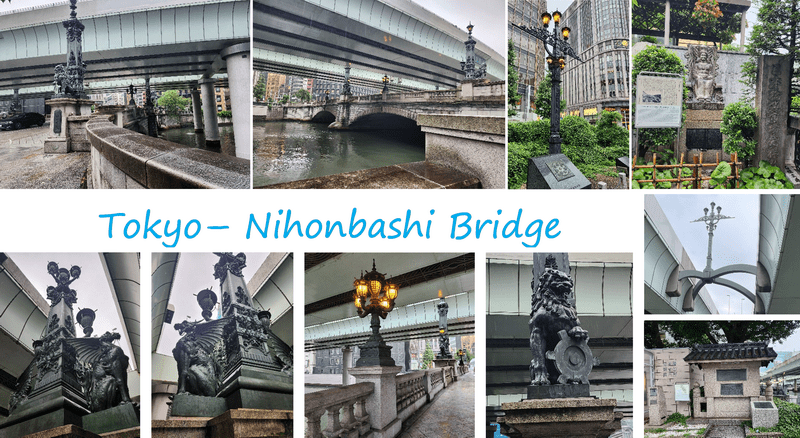
Over time, the bridge had to be rebuilt many times due to fires, breakages, etc. We are now in the 20th generation of the bridge, that of 1911, which has always been positioned back in the same place. The current Renaissance-style bridge is made of steel and stone, has double stone arches and is decorated with symbolic statues and refined lampposts. The bridge was spared from the major events of the Second World War and retains traces of the past.
Like a sacred place, the bridge is guarded by two pairs of komainus positioned on each side of the bridge access. The komainus are strong symbols with a protective role and are represented here by a lion-dog with a strong curly mane and threatening features. Most of the time, the two statues are very similar with some distinctive features such as their mouths. One is open and the other closed. The statue with the open mouth is associated with a man, life or the beginning, the yin, with the sound “a” and it is often installed on the right. You will understand that conversely, the one on the left is associated with a woman, death or the end, the yang and the sound “um”.
Notice that the Komainus have one paw resting on a stone with six points evenly distributed around a circle like the sun, this is the emblem on the Japanese flag of the city of Tokyo.
Then, on both sides, in the center of the balustrade, impressive statues of kirins: mythical creatures with the appearance of protective dragons. Here we have a representation of relatively slender winged kirins, an impressive and intimidating animal mix. The head with horns, its rather colossal mouth, a short beard and its long whiskers remind us of a dragon. The muscular body with scales like a mixture of lion snake on long legs that are close to a horse whose curly tail floats like a flame can perhaps make us think that it can throw fire. Despite the image of power that the kirins give off, it can only be graceful if it is able to fly.
The bridge is easy to walk from one bank to the other. Its length is 49 m (160ft) with a width of 27 m (88ft). In addition to the statues, ornate bronze lanterns embellish the Nihonbashi Bridge.
Some call it the “zero point”, the “zero kilometer” or the “zero kilometer marker”. The purpose is to designate a place in a city where distances are calculated when referred. In large cities, the markers can take the form of a sculpture, an obelisk, a ground plaque to indicate the place. In Tokyo, it is the Nihonbashi Bridge that bears the mark of the zero point in the center of the street.
The bridge spans the river of the same name. The river runs through central Tokyo for 4.85 km and flows into the Sumida River. The Nihonbashi River, like others around it, was designed by man to facilitate the passage and delivery of goods to the heart of the growing city as well as create an obstacle to reaching the castle.
In the middle of the Edo period, the population was estimated at 1.2 million and the existence of large sea passages was essential for the supply of daily goods. Nihonbashi is relatively close to the imperial palace and near the bridge, the area was bustling with a fish market. Over time, shops began to appear.
To facilitate the movement of the population, the construction of a highway was required. The Nihonbashi Bridge was an obstacle and had to be destroyed to make way for the expressway. Fortunately, a group raised their voice to preserve this historical place, successfully. While they initially considered an underground infrastructure, the highway was finally built above the Nihonbashi Bridge due to a lack of budget and time. The goal was to have the highway available for the 1964 Olympic Games.
The modern elevated expressway overshadows the bustling Nihonbashi area, which was once prosperous with well-established and well-known commercial establishments. According to some books, before the new expressway, it was possible to see Mount Fuji.
There is a river excursion boarding pier next to the bridge, which is the starting point for exploring the city from a different perspective. The pier was built in 2011 to mark the bridge’s centennial year.
Our route to get to the Nihonbashi Bridge was not efficient and with the rain we were a little disappointed. I had high expectations. I must admit that I was a little misled by the images available on the web and which are captured at very specific times, with optimal lighting and it is unlikely to be captured during a tourist visit. Although my photos will not be as sensational, the story remains.
Note: Nihonbashi translates to Japan Bridge.
My posts on Tokyo click here.
 Simple Travel and Recreation