
Shibuya
Yoyogi Park invites you to get active and get together with friends and family. Yoyogi Park is divided into two parts and subsections. On the first part, there is a large green area of 54 hectares (133 acres) and on the other part, the concrete sports facilities with the event space.
Without any shows or sporting events at the stadiums, it is the forest nature area that attracts us more with its activity and relaxation areas, in addition to being free to access. A nice breath of fresh air in an environment breaks from the urban traffic. The site includes a loop course and the asphalt area is very popular with runners and joggers.
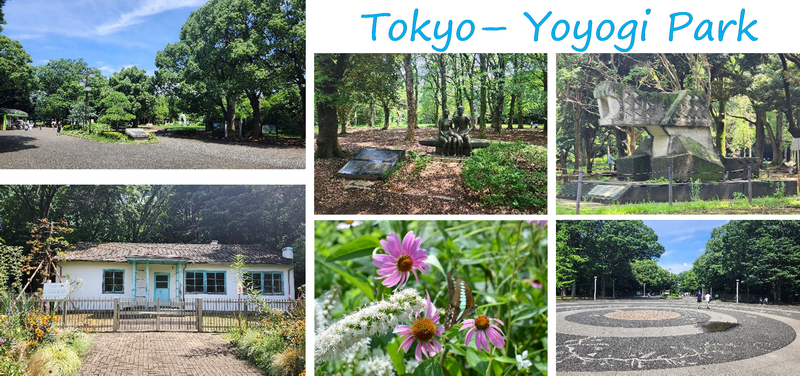
In the Sample Garden area, a flower-lined path leads to a pretty little house that was the accommodation for the Dutch athletes during the 1964 Olympic Games. A bird sanctuary is indicated, but was not a great discovery. We noticed the statue of Quetzalcoatl that was donated by Mexico and the statue of happiness represented in the park by a seated couple and a young child.
According to the site maps, there is a pond there, but when we visited in July 2024, the water pond and fountains were not accessible or visible. The area was being renovated and boarded up, which cut our visit short although we did not go all the way around. People were playing music near a pergola.
Further north, a forest trail is reserved for cyclists only. If you want to explore it, even as a visitor, you can rent a bike on-site. A dog park allows you to let your pet run free in a designated area.
Before the park gate, there is what is called the “summer stage”. It is a circular boundary before entering the park that attracts crowds to admire the performances.
A few traces of the past are camouflaged there in the form of monuments, but we missed them. The site of Yoyogi park was a military training ground and in December 1910, the first powered flight took place there. A commemorative monument as well as two bronze statutes of the aviators are located in the southwest part of the park.
After Japan was battered by war, American forces occupied the area (1945-1952) in an omnipresent manner. During this difficult period, the American presence created turmoil and changed the Japan of today.
The site was revitalized when the space was transformed to host the Olympians in 1964. On the park grounds, the Dutch team’s little house commemorates this event.
It was in 1967 that the site became a public park.
Today, walkers, joggers, runners and cyclists share the planned path. Walking trails are planned to discover the park. Outdoor classes of tai chi, yoga, kick boxing are held by different groups and during our presence, blind runners were practicing with volunteers.
There are four (4) accesses to Yoyogi park on the nature side: the west gate, south gate, Shibuya gate and Harajuku gate. South gate and Shibuya gate connect with the sports fields.
The sports facilities are on the other side of the boulevard. There is the Yoyogi National Stadium or Yoyogi National Gymnasium (Kokuritsu Yoyogi Kyogi-jo) built for the aquatic events of the 1964 Olympic Games and the annex that was used for basketball competitions. The stadium was also used for the 2020 Olympic Games to host the handball events. This large space can be transformed into a concert hall, a performance hall or for sporting events.
When we visited in July 2024, the outdoor area in front of the stadium had been converted into an open-air event with tents.
The Shibuya entrance is the closest to Meijo-Jingu Shrine. Your visit can also include Takeshita and Omotesando-dori which are within easy walking distance.
To access the park, Yoyogi, Harajuku or Meihi-Jingumae stations will take you close to the park.
For all posts on Tokyo click here.
 Simple Travel and Recreation