

1 Bowling Green
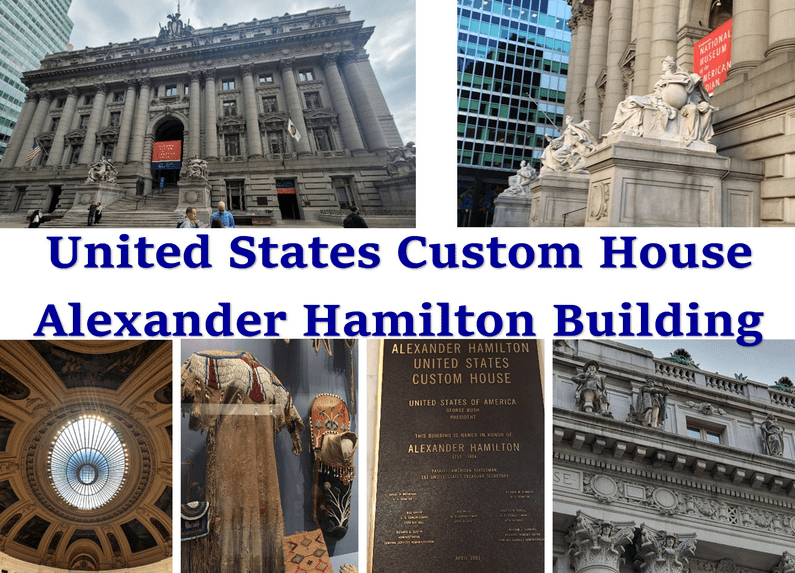
This massive Beaux-Arts building at 1 Bowling Green reminds me of European style. The U.S. Custom House was built in 1907 to process customs transactions, a very important source of revenue for the country at the end of the 19th century. The proximity of the port facilitates entry management.
The building shows different elaborate and thoughtful architectural elements:
- The building faces Bowling Green instead of the port as a courtesy to the historic character of the site;
- The main central entrance is surmounted by a sculpture whose shield is that of the coat of arms of the United States and includes elements of the seal of the State of New York, i.e. two winged figures on either side of the shield and an eagle on the crest;
- The keystones of each window are carved with a face;
- The lower part of the structure shows a certain solidity due to the stone masonry on which the imposing Corinthian columns rest;
- The forty-four columns incorporate the face of Mercury (god of commerce);
- Above each column on the facade sits a statue representing the commercial nations (Greece, Rome, Phoenicia, Genoa, Venice, Spain, Holland, Portugal, Denmark, Germany, England and France);
- The statues are made of white Tennessee marble which stands out against a gray background.
American architect Cass Gilbert designed several major public buildings including the Thurgood Marshall United States Courthouse and the Woolworth Building in New York, the Minnesota State Capitol in St-Paul, the Arkansas State Capitol in Little Rock, the West Virginia State Capitol in Charleston as well as the United States Supreme Court Building and the United States Chamber of Commerce in Washington to name a few.
At street level, four ladies seated on pedestals representing the continents of North America, Asia, Africa and Europe were the creations of another designer.
Works related to the maritime aspect are integrated into the interior and a large naturally lit rotunda is nicely decorated with paintings also recalling the importance of maritime transport: from the arrival of the first explorers to the transatlantic liner. These frescoes were created in 1937.
The Bowling Green building is not the city’s first US customs site. In 1842, transactions took place in what is now the Federal Hall National Memorial. In 1862, activities continued in the former Merchants Exchange at 55 Wall Street before being transferred in 1907 to 1 Bowling Green until 1973 when it was transferred to the World Trade Center.
The 1970s were financially difficult times and little was allocated to the conservation budget. However, the building received historical recognition during the same period which saved it from a probable demolition.
It was not until 1994 that the Smithsonian Museum opened at this location to present, share and preserve a superb collection of arts, crafts, and historical objects related to the culture of American Indians from yesterday to today. The location is significative because it was the site of Native American colonies, landings of the first arrivals as well as Fort Amsterdam (demolished in 1790).
The Smithsonian’s National Museum of the American Indian is open to the public free of charge and, thanks to a donation from Mr. George Gustave Heye, provides access to a rich collection of thousands of objects having belonged to different First Nations from across America. The indigenous community participates in the development of programs, temporary exhibitions, and visual presentations including shows.
In addition to the museum, the building is also occupied by the bankruptcy court.
Although admiring the exterior of the building is impressive in itself, take a few minutes to admire the rotunda and appreciate the museum.
For all post on New York city click here
 Simple Travel and Recreation
wow!! 111New York City – Alexander Hamilton U.S. Custom House / National museum of the American Indian (En)
LikeLike