
476 Fifth Avenue, Manhattan
It is known that libraries contain a wealth of interesting, varied, captivating information, sometimes on real facts and sometimes created from the imagination. The most impressive thing is that each story is different and the public places that welcome us are also sometimes surprising. The New York State Library is one of the libraries you must visit for its exterior architecture, lobby, exhibits, and spectacular reading rooms.
The New York Public Library was born thanks to the legacy of three generous donors, two of whom already offered their book collections to a restrictive public and who were convinced of the importance of sharing knowledge and literary works. The fusion of their works was the beginning of a solid foundation of knowledge. The three men are John Jacob Aster, James Lenox and Samuel Jones Tilden whose names appear on the facade of the building.
In 1895, a new corporation was created under the name: “The New York Public Library, Astor, Lenox and Tilden Foundations” and then confirmed the association of the foundations. It was only in 1902 that the first slab was laid and the opening took place on May 23, 1911. A long journey with a few pitfalls that led to a rich result: rich in knowledge and rich in style. During the construction of the great library, the collections were accessible to the original spaces.
Mr. John Bigelow deserves the credit for bringing the funds together towards a common goal. Plus, Andrew Carnegie’s contribution allowed the addition of satellite branches spread on and around the island of Manhattan, all linked to the New York Public Library.
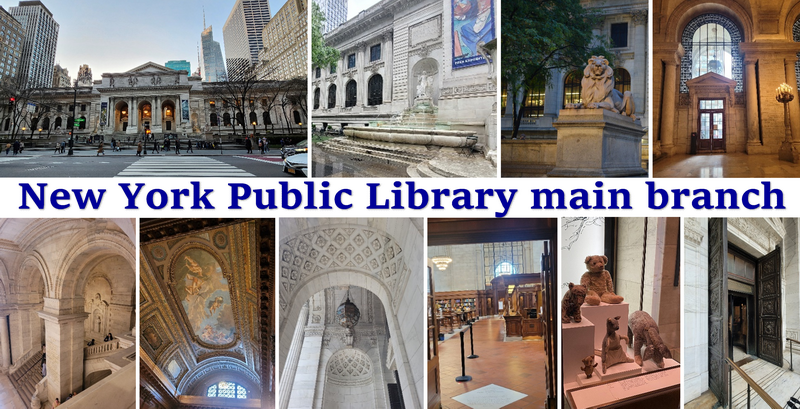
The impressive structure on Fifth Avenue at the intersection of 41 Street East in Midtown, Manhattan is the central building, the second largest library in the United States after Washington. It is built of marble, has 3 floors and a basement and attracts many visitors and for good reasons. Its rectangular shape, 390 feet long and 270 feet deep, is far from ordinary. A little set back from the street, you will reach the front doors once you have walked two levels of stairs, the plateau of which is flanked by two imposing lions called Patience and Fortitude. The library shares its vast grounds with Bryant Park which continues from the back to the front of the building on the side parts. Before accessing the staircase leading to the entrance, fountains have been installed on both sides. One of a woman sitting on Pegasus represents Beauty and the other, of the man sitting on the Sphinx, represents Truth. Also, note the six men at the top. They invoke history, theater, poetry, religion, romance and philosophy.
As you enter the library, see the high ceilings and stairs on either side. You don’t have to climb the steps or reach the elevator right away because one of the rooms to see is on the ground floor. This is the Polonsky “Treasures” exhibition. In this room, with white marble columns veined with green and carved wooden ceilings, we find unique and original objects from the phenomenal library collection of items. I noticed the original stuffed animals that inspired Winnie the Pooh, a Charles Dickens desk and chair, and an original copy of the Declaration of Independence but I missed the Gutenberg Bible.
Access to the library and the Treasures exhibition is free to roam around. On the other hand, certain rooms, such as the majestic Rose Room, must only be accompanied during a guided tour which, by the way, is also free but must be reserved in advance because the number of people on a tour is limited.
I guess I don’t need to remind you that you are in a library. Please respect the users even if your goal is to admire the architecture.
If you choose to stay there for several hours, know that you are in the heart of the city and that you will find options for dinner in the neighborhood.
For all posts on New York City click here
 Simple Travel and Recreation