
Around a plaza, 7 buildings made up the World Trade Center (WTC) and included the twin towers which stood out from the other buildings with their 110 floors (440m high), from the end of construction in 1973. Several large international companies occupied the buildings, tens of thousands of people came to work there daily and the 107th floor observatory and open-air roof terrace were very popular. Visitors from all over the world chose to admire the city there, until the fateful day of September 11, 2001, when the Twin Towers crashed.
Deliberately targeted, two commercial planes with several passengers on board were hijacked by terrorists and flew directly into the towers at the start of the day, before 9AM. A few minutes later, the structural shocks were such that the towers collapsed to the ground, causing impacts on the surrounding buildings.
That day, other planes were hijacked and reached other targets on American soil.
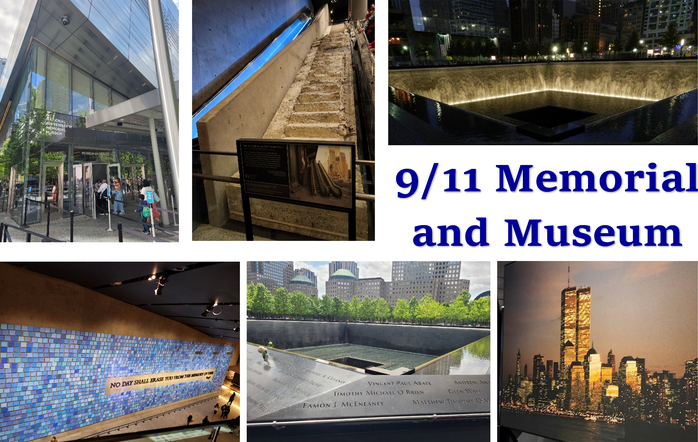
It would take days to clean everything up, months to redesign the site and years to rebuild. It was impossible to satisfy everyone. A memorial where the towers were located, a museum and new towers remake the landscape of the area still in development at the time of our last visit in March 2024.
The Sphere, created in 1971 by sculptor Fritz Koenig, was originally located in the Central Plaza of the WTC. It was miraculously recovered from the rubble and is now in Liberty Park.
The memorial
The memorial is two huge square pools with built-in waterfalls where water flows into a central void. The night lighting is calming. The whole thing was named “Reflecting the Absence”. Each pool is surrounded by a bronze plaque on which the names of the victims are engraved.
The memorial has been completed 10 years after the event and can be accessed free of charge from 7:30 a.m. to 9 p.m. It is a serene place where 400 oak trees have been planted in the square and, in addition and miraculously, a pear tree has been replanted in the exact location where it managed to survive. In spring, the blooming tree carries a message of hope and renewal.
The museum
180 Greenwich St
The museum brings us back vividly to the shock of the moment, September 11, 2001. With audio and video recordings, personal and sometimes commercial objects that were found on the scene, testimonies of rescue operations and analysis of the events, the visitor is exposed to an intense grouping that shaped the before, during and after of the tragedy.
A personal audio and photo tribute to each of the 2,973 victims are presented in one of the rooms.
Among the thousands of objects presented, I was touched by the shoes, the store where clothes are covered in ash, a partially burned identity card, a wallet, a merged multi-level structural piece, the abandoned bicycles, the fire truck distorted by the intense heat of the moment, an old corded telephone as well as a distorted pay wall telephone, corporate documents and the Warner Bros. sign. – WB “That’s all folks” which has a whole new meaning now. Since photos are prohibited in this section, it is difficult to remember everything.
The museum takes us back as far as the initial construction, the symbolic reference, the numerous film appearances and the scale of the towers in the financial heart of New York.
We learn that the attack of September 11, 2001, was not the first attack on the site. The explosion of a bomb took place on February 26, 1993, during which 6 victims were killed in the underground commercial part of the building. The names of the victims have been added to the memorial.
Obviously, with the technology available and the location of the tragedy, there are shocking images that were captured live of certain critical moments, by cameras and telephones. It is, therefore, possible to hear the trembling voices of future victims who leave their last messages, the relatives or friends worried about hearing from a loved one and live moment of a journalist.
We know that the first responders faced a monstrous challenge. Many lost their lives there. Some survived but deeply affected. We recall the heroic work of the firefighters, police officers and how the local population endured this intense moment of stress.
I was amazed by the wonderful movement of mutual help from employees who managed to transport their colleague in a wheelchair out of danger. The welcome of nearby stores to protect people against the debris and dust which was coming like an immense tsunami, the very beautiful collaborative work of the rescue boats which mobilized to evacuate the island while all the bridges were closed and the Saint-Paul chapel which was a place of rest, supply and first aid to people in need.
The museum also addresses the diabolical organization behind these actions.
The museum is located in the basement of the towers and there are historical remains of the original construction. Twisted beams, the evacuation staircase which was the escape route for many employees, the last column and 36m of steel, were the last to be moved after the major cleaning, messages of hope, and search notices.
The site also includes works. The blue wall is the work of Spencer Finch entitled “Trying to Remember the Color of the Sky on That September Morning”. Although all 2,983 tiles are blue, none have the same shade. It was a bit like the difference ways each of us experienced the shock. Written on the wall: “No day shall erase you from the memory of time – Virgil”. Even the letters of the message are forged from metal waste from the towers. It is said that behind this wall are kept the remains of loved ones who, to this day, are extremely difficult to identify.
The museum, opened in 2014, is not free of charge and will take you several hours to visit. The site is powerfully emotional and some might find it difficult to revisit this very real nightmare.
The museum and memorial aims to remember each of the victims.
You are next to Liberty Park and the Oculus.
For all posts on New York City click here
 Simple Travel and Recreation