
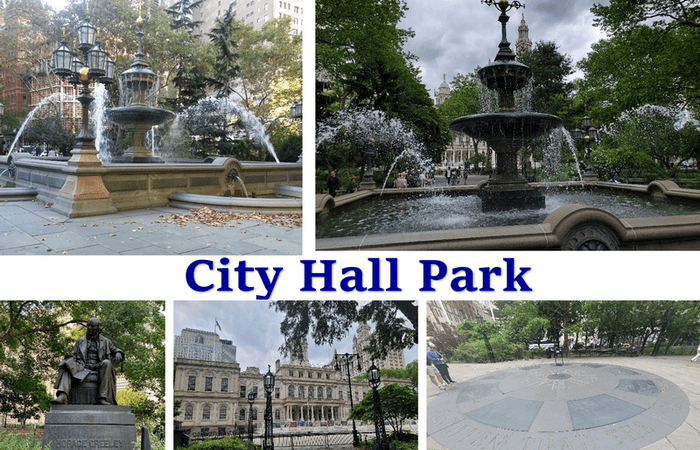
The attractive urban park is fascinating and includes a fine series of historic establishments.
The park is located very close to the Brooklyn Bridge, so it is easy to discover both attractions on the same day.
Due to its location, it seems natural that this Civic Center park was a political meeting place long before Washington D.C. was the federal capital. Indeed, it is in the park of City Hall that the Sons of Liberty raised the flag of the group. The mast that you see on the site today is not the original because it was removed several times by opposing troops and reassembled by “American” claimants of the land, but the mast reminds us of this historical element. It is also an important mark of history as it was here, in 1776, that George Washington read the Declaration of Independence. After this event, the Sons of Liberty went to Bowling Green to remove the statue of King George, a British symbol.
The fountain
In the park, we find the very pretty Jacob Wrey Mold fountain which was reinstalled in 1999 after being abandoned in another park in the Bronx. The refreshing work was originally installed in the park in 1871 before being moved. Unfortunately, several architectural elements were stolen so it needed a bit of revitalization before it was reintroduced onto the grounds of City Hall.
City Hall
The fountain is on the central path that leads to the Town Hall. There are organized tours in the Town Hall twice a week on business days only so reservations must be made in advance. Although it was not the first New York City Hall built, this 1803-1812 construction holds the acclaim of the oldest continuously functioning city hall in the United States. The office of the mayor of New York is located there as well as the chambers of the city council. There are over 51 councillors who represent 51 districts spread across the city’s 5 boroughs.
This important structure of the city had to be redesigned from the original plans. The budget and the context of the city were forced to make concessions on the plans and materials at the time of construction. The work was staggered over a long period due to labor disputes and the yellow fever that raged during this period. You will no doubt notice its serious facade with its dominant columns and the central cupola. The statue of Lady Justine is perched high above the dome.
Metro
One of the oldest metro stations (1904) in New York is located in this park. However, there has been no stop at this station since 1945. Luckily, it is accessible, but to visit it, you must take a guided tour. They say the architecture is worth it. I didn’t have the opportunity but maybe you will.
Website: here
Monuments
I told you that the park is full of historical elements and that’s not all. Sitting on a granite base, the statue of Horace Greeley is part of the landscape of the park. He was the founder and publisher of the New York newspaper, Tribune.
Without perhaps realizing it, several trees in the square are those that were shaken by the collapse of the towers in 2001. Indeed, some trees that were in bad shape but alive were transplanted to the City Hall. This was a tribute, a help and a mark of empathy from the Prince of Monaco who partly finances the maintenance of the premises. In spring, the trees with white flowers are a balm on the damaged hearts of the loss of a loved one or the sad reminder of this disaster.
During working days, the dynamic of the park is quite different from that of the weekend. Municipal workers come here to take a lunch break, while on weekends, access to City Hall is fenced and it is rather quiet in the park.
Behind City Hall there is a pedestrian walkway and facing Chambers Street, the Tweed Courthouse backs onto City Hall.
Tweed Courthouse/ Old New York County Courthouse
52 Chambers Street
The old courthouse in New York is still on the site of City Hall Park. The building faces Chambers Street and presents a solemn architecture.
Construction began in 1861. Work was interrupted in 1871 following the death of John Kellum, the architect and the exposure of an important file of corruption, that of chef William M. Tweed who, with his team, embezzled at least 30 million dollars of public funds for personal needs. We do not know the exact value but the estimate showed that the construction was well over budget and that the money pocketed by politicians could even reach 100 million. “Boss” Tweed, who controlled New York state and city governments, was jailed for this massive fraud.
Nevertheless, the architectural work is highlighted and, ironically, even reference is made to the Tweed courthouse.
The interior layout and work were completed in 1881, and thus the second oldest building in the borough after City Hall served as the New York County courthouse.
The building now houses the school board (the New York City Department of Education’s headquarters) on the upper floors while classrooms are on the ground floor.
The site is said to be haunted by Mr. Tweed but you should also know that before the construction of the two buildings of City Hall Park, around 1685, the ground was used as a place of punishment for prisoners as well as an African burial site. There would still be eight graves under the courthouse and a memorial was erected not far away.
 Simple Travel and Recreation