
89 Broadway
One way or another, the chances of you coming face to face with this historic institution are high if you walk around Lower Manhattan, especially if you are in the financial district near Wall Street or the World Trade Center.
In all honesty, the view from Wall Street is awesome with the perfect alignment with the central church steeple. You should know that this was not always like this. The first Trinity church, 1698-1776, faced the Hudson River with a more modest elevation on land permanently granted by Queen Anne in 1705 after the six years of a provisional loan granted by the British Crown which was at that time under the reign of King William III of England.
Very quickly, the population of New York increased and the church became too small. First, St. George’s Chapel opened in 1752 on the corner of Beekman and Cliff Streets. Then, in 1766, St. Paul’s Chapel on the corner of Broadway and Vesey Street, invited people. The latter is the oldest construction in the city to be in continuous use.
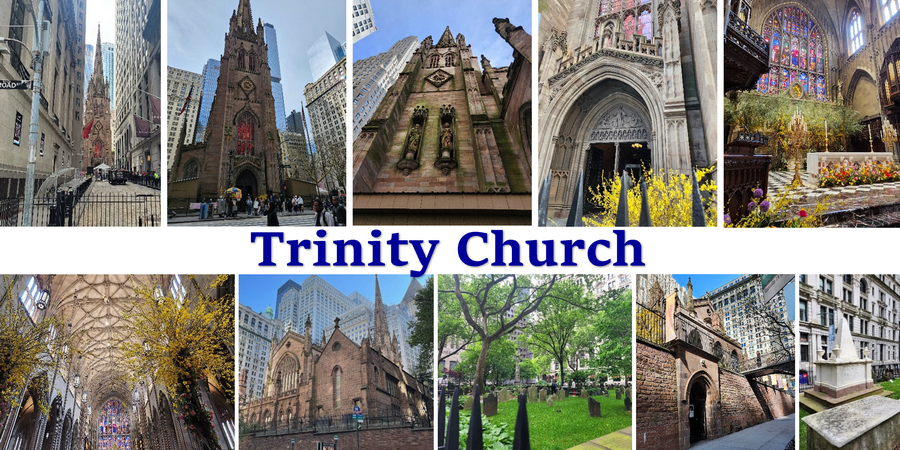
In 1776, the great fire of the Revolutionary War ravaged Trinity Church. The religious building was rebuilt and consecrated in 1790 and the church broke away from the churches of England to join the Episcopal churches, related to the Anglican community. The second building faces Wall Street, but because beams showed signs of sagging from snow accumulation, it had to be demolished. A third construction, that stands today, was erected between 1839 and 1846, with a capacity of 652 guests and is more solid.
The church has an imposing central bell tower with 23 bells, 8 of which were recovered from the previous church. With its spire and cross, the historic building reaches 281 feet (86 m) high. Although today, it seems very small among immense buildings, there was a time (1846 to 1860) when the building was the tallest in the United States.
Adjoining the place of worship is one of the church’s three cemeteries. Saturated by space, it has ancient graves of historical figures, war heroes, American representatives and members of Congress, in addition to Alexander Hamilton, founding father and American revolutionary patriot, Francis Lewis signatory of the Declaration of Independence, and Robert Fulton associated with the invention of the first steamboat. The oldest date is from the 17th century.
Access inside the church is free, but you must go through a security checkpoint. The interior is dark, but note the altarpiece with the statuettes and the stained glass windows
Also, take the time to visit the cemetery. A panel shows the location of several graves and there are plaques showing the history of the people which are next to some monuments.
If you arrive via Trinity Place instead of Broadway Street, you will notice that you are below along a stone wall. There is a bricked access to the site: the Cherub Gate. Pay attention to this portal which contains a unique piece dating from 1680 from London. As the commemorative plaque indicates, this is a gift from the sister church of St. Mary-le-Bow in London as a thank-you for the financial support for the reconstruction of their church. Founded in 1080, it was razed in May 1941, by German bombings. We were then during the Second World War. The cherub’s head was discovered in the rubble during the reconstruction.
Interestingly, according to the St.Mary-le-Bow church website, there is no mention of the gift indicated above, but of another relic. A stone from the crypt would have been placed in the New York church of Trinity in 1914. This would be a reminder of the contribution of King William III in granting privileges to the two religious sites, confirming the connection between the churches.
For all posts on New York City click here
 Simple Travel and Recreation