

185 Greenwich St
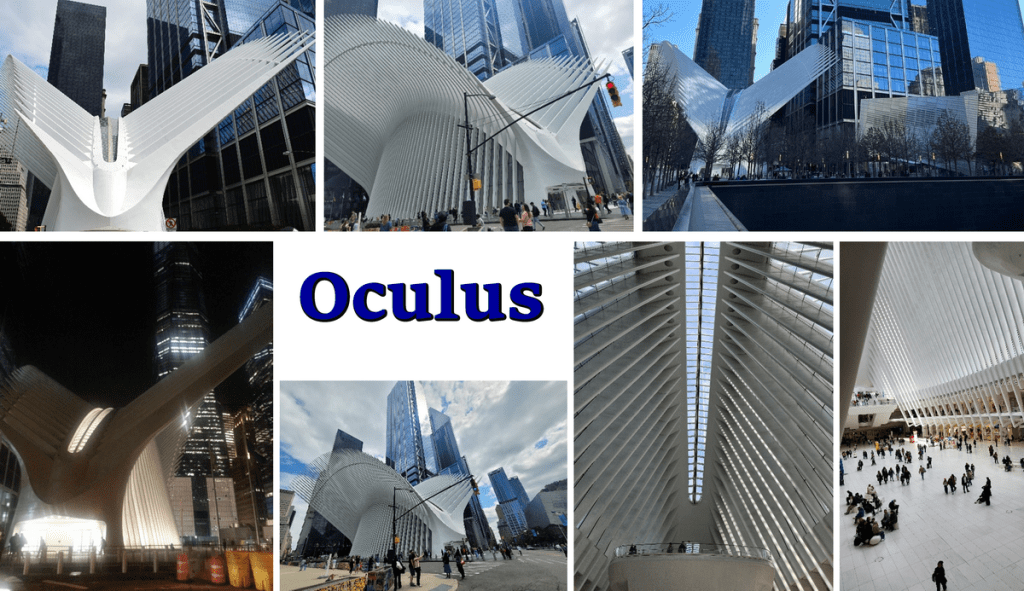
The Oculus points to the entrance to the new underground World Trade Center station, which is part of the structures rebuilt after the fall of the World Trade Center towers on September 11, 2001. Finalized in 2016, the surface structure is a commemorative artistic work, modern, stylistic, grandiose, pure white, in the shape of a bird spreading its wings symbolizing freedom and peace in this place which has experienced significant trauma.
The creation stands out through its style, its color, and its relief in the urban environment of Lower Manhattan where office towers with four gray facades are getting taller and taller. Here, the immaculate white steel construction reminiscent of a dove brings life and movement.
Defying the basic principles of steel structures, the achievement is none other than that of an architect capable of defending his principles with engineers, Mr. Santiago Calatra.
The production has a quadruple scope: memory, movement/living space, transportation hub and artistic work.
Memory
On September 11, 2001, seven buildings in the Lower Manhattan business center collapsed after two planes struck the twin towers of the World Trade Center. The city, the country and the entire world were troubled by this tragic event.
It took days to clean up, months to start being reborn again, years to find a reconstruction plan and we will never understand how humans can attack other humans like this.
Symbol of freedom, liberation and peace, the dove that flies away has certainly been chosen judiciously.
The pure white architecture allows the natural light to pass through and descend into the central atrium.
At the top, crossing the atrium at its highest point, part of the structure opens to let in air and sunlight when necessary. The orientation of the structure was strategically aligned with the sun at 10:28 a.m. on September 11. Every year, to remember the tragedy, the retractable section opens on September 11 at 10:28 a.m. for 102 minutes, the time between the initial plane impact and the collapse of the second tower, to let the rays of light pass through a message of a better tomorrow and that all is possible.
Movement/living space
There is a lot of movement in this urban space in fact, but the station is the reason for this development. The size of the station is such that thousands of people commute to access New York’s underground transportation network.
Under the Oculus, there is also a shopping center with more than a hundred shops and restaurants for other passing customers looking for a place to eat or go shopping.
The ground floor entrance gives an overview of the oval atrium leading to the underground areas: the shopping center and the train station. The station is a major hub in the city that connects with stations beyond the city limits.
There is no need to emphasize again that the movement is found in the structure of the bird with outstretched wings.
We must not forget the tourists who come to discover the places and capture interesting angles of the monument with their cameras. The atrium is, at times, decorated and occupied to highlight events and make the place more festive.
Artistic Work
The architectural envelope above ground level is remarkable, illuminated and with no specific functionality other than architectural, commemorative and reminds us of nature in an urban center. This work is of a magnitude that impresses us in terms of the potential of structural architectural creativity which seems to defy the law of gravity and where the skeleton of the construction is exposed, decorative and part of the final product.
Santiago Calatra’s skeletal style of white steel can also be recognized in other works including the Florida Polytechnic University and the Milwaukee Art Museum in the United States; in France, at the Liège-Guillemins railway station; in Italy, the Reggio station Emilia AV Mediopadana, or the science museum in Valencia in Spain (Museu de les Ciències Príncipe Felipe) and in Brazil, the Museum of Tomorrow.
It is interesting to see unique architectural elements in the new construction, such as in the era of industrial development.
For all posts on New York City click here
 Simple Travel and Recreation