
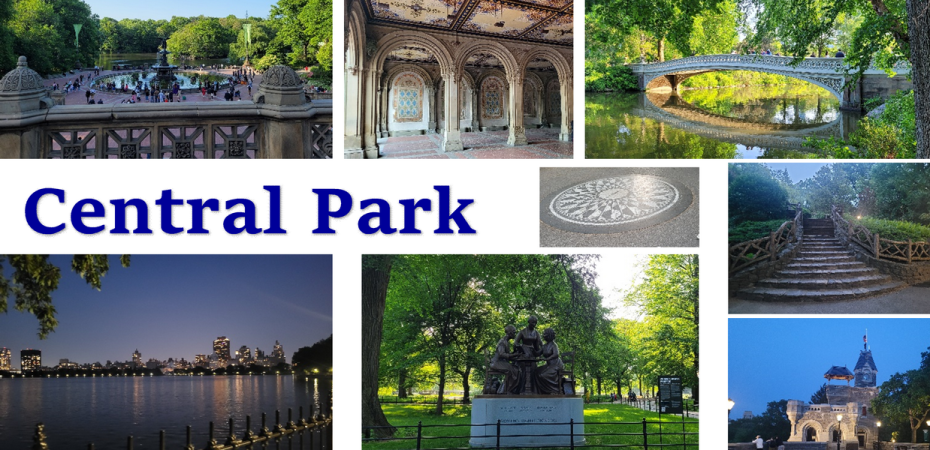
There are so many sites touting Central Park so I need to talk about it. The park deserves all our appreciation. It is huge and there is no perfect, unique route. The chances of taking the wrong turn on your first visit are very high.
There are information kiosks at the Columbus Circle side entrance where paper maps are available. Let yourself go with the times and don’t worry if you can’t see it all. Enjoy what you can.
Central Park is a quadrangle perfectly bounded by 110th Street to the north; 59th Street to the south; Eighth Avenue on the west side and Fifth Avenue on the east side. Central Park is surrounded by prestigious residences and museums such as the Metropolitan Museum of Art, the Solomon R. Guggenheim Museum, the Jewish Museum, the Frick Collection and the Museum of the City of New York in addition to the Zoo and the Conservatory Garden of the east side and the American Museum of Natural History on the west side.
We chose to visit Central Park on the day we arrived, at the end of the day, due to the expected rain the next day. We easily spent 4 hours there plus a stop for dinner. It is possible to cover it a little faster if you choose to travel through the park by bicycle or in a horse carriage. That being said, you will still have to explore via the pedestrian paths to access several attractions.
Here is what we managed to see:
- Sheep Meadow
- Carrousel
- The Mall and Naumburg Bandshell
- Bethesda Fountai Terrace and arcade
- Bow Bridge
- Strawberry Fields
- Swedish Cottage
- Shakespeare Garden
- Belvedere castle
- The Reservoir
Here is a link to the official website to create your ideal circuit
Sheep Meadow
Sheep Meadow is a large, open, grassy area that has become a place for relaxation, picnics, meetings and recreation. Some people opt for frisbee while others for a ball game.
At times the site became a place of claim or protest. It was a site of military demonstrations and now it is more often than not a place of peace and freedom.
Carousel
It turned out that we missed our first destination in the park. Believe it or not, we missed the crossing and decided to move on to the next stop instead of turning back due to a matter of time.
The carousel has been part of the park since 1871. It has been modified over time and has not been mule and horse operated below ground level since 1924.
Today the paying site has 57 hand-sculpted horses as well as two decorative floats that have been welcoming customers of all ages to classical music since 1908.
The Mall
This wide promenade surrounded by mature trees and monuments brings us to Bethesda Terrace. Do not miss the monument dedicated to the pioneers of women’s rights.
Naumburg Bandshell
Renamed Naumburg in honor of Elkan Naumburg, a New York resident who became involved in the arts in the city, this mini amphitheater is a great background for your photos.
Bethesda Fountain, Terrace and Arcade
In all honesty, I was blown away with this whole Central Park subsite. When I thought I was moving towards a viewpoint on the plains, I was amazed to see the lake and the fountain and when I was wondering if we should get closer, what a mistake it would have been not to go there. Under the terrace, a magnificent tunnel gives the impression of a clandestine church whose acoustic quality highlights the voices of the artists and whose walls and ceilings form an European backdrop.
Let’s take it step by step. One of the largest fountains in the city, reaching 26ft high, has stood here since 1863. The bronze statue in the center of the 96ft wide basin is of an angel carrying a lily in one hand and symbolizes access to water. The 8-foot statue is hoisted atop a column featuring four cherubs representing health, purity, temperance and peace. It is part of the original plans for the park. Be aware that in winter the basin of the fountain is drained.
If you have a choice, I suggest approaching the fountain at street level (72nd Street cross drive) for a full view. As you walk towards the balustrade, you discover part of the beauty of the site: the fountain, The Lake, the greenery and the overall view. However, your visit would not be complete without going to the lower level as well. Whether approaching the fountain or the lake, you will notice that the pedestrian tunnel, under the balustrade, is grandiose. Its arcade, the decor of tiles on the vaulted ceiling and the wall sculptures are worthy of castles. To access it, take one of the two large staircases located on either side of the balustrade.
Bow Bridge
Definitely romantic, Bow Bridge could easily be used for a Victorian-era film. Connecting Cherry Hill to the Ramble, this little white cast iron bridge, accented with urns, has straddled The Lake since 1862.
On the side of Cherry Hill, a small projection, with a side view in the background of the Bow Bridge with its arabesques, is designated as the marriage proposal spot.
The site is where we took some of the most beautiful photos in the park.
Strawberry fields
Located on the west side between 71st and 74th, Strawberry fields pays homage to the late Beatles singer, songwriter John Lennon, who was murdered nearby in December 1980. The venue, funded by his wife Yoko Ono, is humble and sometimes embellished by the presence of street artists who come to interpret his works.
(See Dakota Building nearby)
Swedish Cottage
After our lunch break on Amsterdam Avenue a few steps away, we returned to the park by the access near the American Museum of Natural History.
We came across the Swedish Cottage but it was without planned activities and very quiet. Brought directly from Sweden in 1877, it had been built a few months earlier. The Swedish cottage has been used for several purposes, including defense headquarters during the Second World War and a library, but since 1947 it has been the puppet theater of the park.
Shakespeare Garden
The visit to this garden was in our plans but here I was a little distracted by the presence of rats at nightfall. I did not take the time to sit down to contemplate the flowers. Anyway, the gardens are not lit at night. The winding paths invite you to discover the colorful plantations.
Belvedere castle/tower
Located on the second highest point of the park, the first being Summit Park, the so-called castle is an imposing observation structure high above a rock, Vista Rock, whose magical architecture gives the air of a fortress but which has never had a military vocation and is not associated with a former prestigious residence descended from the nobility. It is rather a medieval-style lookout post, an observation landing to appreciate the beauty of the landscape.
Built in 1865, the meteorological services have been taking their data from the Belvedere since 1868.
Multiple levels allow visitors to explore several angles of the surroundings. Towers are not always open. Despite everything, even on the first level, you will have a superb view of the Turtle Pond and the Delacorte open-air theatre. If you choose to relax in the park on the other side of the pond, the view of the castle and its tower gives a princely image to the place.
Depending on the season or the time of day, the view from the Belvedere changes. This enchanting place is loved by photographers, brides and grooms-to-be.
The Reservoir
It is the largest body of water in the park and is surrounded by a 1.58-mile (2.5km) boardwalk giving viewpoints of the city. It is known as the Jacqueline Kennedy Onassis Reservoir.The construction of 1862 was intended to supply the city with drinking water, which is no longer necessary.
The surprising stone building by the water is the South Gatehouse. This place housed the dispatched center system for the water distribution for the city.
For all posts on New York City click here
 Simple Travel and Recreation