
89 East 42nd Street
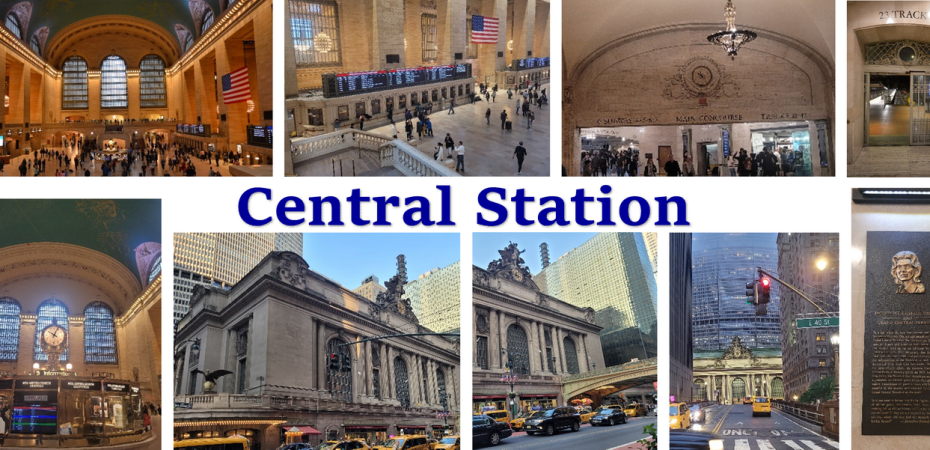
I had set foot there more than 25 years ago and I had not been as impressed as this year. For good reason, the Grand Central Station/Terminal has been revamped to bring back to life the soot-covered decorations of yesteryear.
Destined for demolition, the tangible actions of the former first lady, Jacqueline Kennedy Onassis, saved the historic establishment. A commemorative plaque in the station pays tribute to her.
The exterior building is impressive on 42nd Avenue. The facade with the largest Tiffany clock in the world seems quite small, seen from the ground, but is 14 feet in diameter. At the very top, the statutes of the Roman gods Mercury, Hercules and Minerva are absolutely beautiful. A little lower, an eagle with outstretched wings, an American emblem, is present.
Inside, the main hall has several interesting features. The ticket counters remind us of construction from the very beginning of the 20th century. The cream marble floor is ascended by two staircases on one side and one on the other. Three large bay windows give a cozy luminosity to the interior space. The large chandeliers are massive and give richness to the place. The starry ceiling at 38 meters is particularly pretty. Some will note the reversed order of the constellations. A central no-access information kiosk is topped with a high-value four-sided clock covered with opals and brass. Employees access it via a floor hatch.
In the underground corridors, the architectural concept of the arches created the Whispering Gallery. Despite the distance between the two arches, whispers easily carry from side to side as if you were right next to the person opposite to you.
Although this building is historic and dates from 1913, part of the current space was used from 1871 as a central station. It was then called Grand Central Depot. The first expansion took place in 1900 and again from 1903 to 1913 after a tragic collision in 1902.
The construction of the original 1870 work is that of Commodore Cornelius Vanderbilt. His involvement in railway development is underlined in the current architecture under the symbols of acorns and brass and his statue faces Park Avenue. One of the arteries adjoining the station also bears his name.
We sometimes hear Grand Central Terminal or Grand Central Station which are to be distinguished. The Grand Central Terminal is for rail service (44 platforms and 67 tracks) to meet regional transport demands and the Grand Central Station is for the metro (correspondences for lines 4,5,6,7) and the post office.
You have to go to Penn Station for mainline travel.
This historical place goes beyond the transport offer. It is a meeting spot where tourists and locals will appreciate its market of fresh products, restaurants, shops, bars, and two tennis courts. It is, therefore, possible to spend more time than an hour. There are also guided tours if you are interested.
The station is located in the Midtown area. The main entrance is on 42nd Street and Park Avenue near the Chrysler building.
For all posts on New York City click here

 Simple Travel and Recreation