
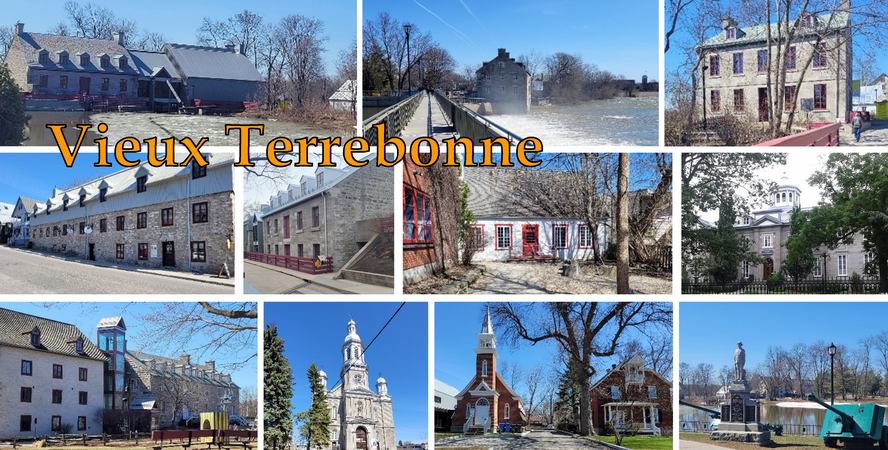
Discover Old Terrebonne
Located along the shores of Rivière des Mille Îles, Old Terrebonne is a charming historic district known for its well-preserved architecture, cultural heritage and vibrant community life. The area features cobblestone streets, historic buildings from the 18th and 19th centuries, and notable sites such as Île-des-Moulins and the former Collège Saint-Sacrement, a key institution in the region’s educational history. Visitors can explore walking trails, museums, and public art, or enjoy local cafés, restaurants, and boutiques. Old Terrebonne also hosts cultural events throughout the year, offering beautiful, entertaining and even romantic opportunities.
Ile-des-Moulins
In Old Terrebonne, one of the must-see spots is Île-des-Moulins. Whether you’re looking to go for a walk, train outdoors, enjoy public art, admire historical architecture, feel the power of the rushing water, or spot blue herons nesting, this island has something for everyone.
Île-des-Moulins (which translates to “Mills Island”) was once the heart of one of the most significant seigniorial estates in Quebec’s history. Today, it stands as a vibrant cultural and historical hub in the region. Facing the Rivière des Mille Îles, the island offers scenic walking paths lined with beautifully restored heritage buildings that once harnessed the river’s power for milling and production. From the 1720s to the 1940s, this site hosted flour and saw mills, a bakery, and administrative offices.
After a period of neglect, restoration efforts breathed new life into the island. Today, the renovated buildings house a variety of public spaces, including a restaurant, a public library, and a small event hall. These are all nestled within a picturesque setting that’s enjoyable year-round. Though the island is pedestrian-only, it’s just a short walk from nearby parking areas.
You’ll also find numerous picnic areas, and in winter, the central pond transforms into a charming outdoor skating rink. Throughout the park, public artworks enhance the landscape and add to the experience.
Accessing the island is easy via a quaint wooden footbridge from Old Terrebonne. Additionally, a pathway over the dam leads to adjacent Île Saint-Jean and its park, making the area part of a broader network of green spaces to explore.
Parc Masson / Parc des Braves
When arriving by car, you’ll likely pass by Parc Masson, located on rue Saint-Louis in front of Collège Saint-Sacrement.
Joseph Masson, a prominent seigneur of Terrebonne and a successful businessman, once owned the land. After his death, his widow had a manor built—this building now serves as the main façade of Collège Saint-Sacrement. To open up the view, the structures that originally stood in front of the manor were demolished. Following her passing, decorative pavilions, or gloriettes, were erected on the grounds. The land was eventually donated to the city, under the condition that the gloriettes be preserved and the area transformed into a public park.
On one side of Parc Masson, you’ll find a monument dedicated to the bravery of local residents who served in past wars. Their names are engraved on the memorial as a lasting tribute to their sacrifice.
Parc de la Pointe-de-l’Île
This park is accessible via the pathway that runs over the dam, making it a natural extension of your walk. It’s a peaceful spot where we were lucky enough to observe blue herons nesting — a treat for birdwatching enthusiasts. Along the trail, you’ll also find gentle fitness stations with exercise instructions, perfect for those who enjoy staying active in a relaxed, outdoor setting.
Parc des Jardins Vitrés
This charming park is located beside and behind the Théâtre du Vieux-Terrebonne and its parking area. It features a playground, making it an ideal stop if you’re visiting with children—they’ll enjoy climbing, playing, and burning off some energy. From the park, it’s just a short walk to reach the Hôtel de Ville (City Hall), making it a convenient and pleasant detour during your visit.
Public Art
Old Terrebonne is a vibrant cultural hub, showcasing a diverse array of public art in various forms. Visitors can explore sculptures scattered throughout the area, such as the striking pieces along the paths of Île-des-Moulins and in local parks, which reflect the town’s rich history and creative spirit. Murals also adorn the walls of buildings, bringing color and life to the streets, with some depicting local heritage and others inspired by contemporary themes.
The local stores contribute to the artistic atmosphere as well, displaying unique artwork created by local artists, allowing visitors to experience art in everyday spaces. The theatre, a cornerstone of Terrebonne’s cultural scene, regularly hosts performances that often incorporate elements of visual art and design, further enriching the artistic landscape.
Additionally, the event room at Moulinet, located on Île-des-Moulins, serves as an important venue for art exhibitions and cultural events, where temporary exhibits or performances highlight both regional and international artists. Together, these sites make Old Terrebonne a dynamic destination for art lovers and a place where creativity is deeply woven into the fabric of daily life.
Dining and Beer
Old Terrebonne boasts a variety of cafés, restaurants, bars, and sweet shops, offering something for every taste. Whether you’re enjoying a cold beer on a sunny terrace, savoring a piece of gourmet chocolate, or indulging in a fine dining experience—or perhaps a more casual meal—there’s no shortage of options. The area has a lively, festive atmosphere, making it the perfect place to relax, dine, and enjoy the local flavor.
Terrebonne City Hall
Located in the heart of Old Terrebonne, the City Hall is a landmark building in the city. Built in 1931, it replaced the former city hall that was destroyed by a fire in 1922. Its construction during the Great Depression also aimed to provide local jobs. At the time, the building served both as an administrative center and a fire station. The tall tower had a specific purpose—it was used to hang and dry fire hoses.
The building, designed in a neoclassical style, is made of red brick with concrete foundations. It has a flat roof and several distinctive features, including a flagpole and a small tower. The façades are simple yet elegant, and the main entrance is decorated with columns and patterned brickwork.
Today, the City Hall still houses municipal administrative services. It is recognized as an important heritage building and is a key part of Old Terrebonne’s historic landscape. It remains a meaningful place that reflects the city’s evolution over the years.
Théâtre du vieux Terrebonne
866, rue Saint-Pierre
The Théâtre du Vieux-Terrebonne is a prominent cultural venue located at 866 Saint-Pierre Street in the historic district of Vieux-Terrebonne, Quebec. Established in 1947 as the Théâtre Figaro, it transitioned into a cinema in 1948 and was renamed Cinéma de Terrebonne in 1975. Acquired by the City of Terrebonne in 1986, the theater was officially relaunched in 1988 under the management of the Société de développement culturel de Terrebonne (SODECT). In 2004, the theater was renovated and expanded to its current capacity of 656 seats.
The main venue, Salle Desjardins, is designed in a semi-circular “cauldron” shape, ensuring excellent visibility from all seats. It features a 441-seat orchestra section and a 215-seat balcony, along with four loggias that can accommodate up to six people each. The theater is fully accessible and equipped with modern amenities, including assistive listening devices for the hearing impaired.
Adjacent to the main theater is Le Moulinet, an intimate venue located on Île-des-Moulins in the historic Moulin Neuf. With a capacity of 116 seats (or 200 standing), Le Moulinet offers a cabaret-style setting for smaller-scale performances. It has hosted a diverse range of artists, from emerging talents to established performers seeking a closer connection with their audience.
The Théâtre du Vieux-Terrebonne is recognized as a central hub for cultural dissemination in the Lanaudière region, offering a varied programming that includes theater, music, humor, classical music, jazz, and more.
While the theater is situated in a urban setting, parking can be challenging during the summer months due to increased tourist activity in the Vieux-Terrebonne area. Public parking is available nearby but may fill up quickly during performances or events on Île-des-Moulins.
For more information on programming and ticketing, visit the official website.
The Surrounding Streets
In Old Terrebonne, several streets are especially popular due to their historical value, picturesque atmosphere, charming shops, and central role in the area’s cultural life. Here are some of the main ones:
Saint-Louis Street
I highly recommend taking a walk along Saint-Louis Street to fully appreciate its charm. This historic street is lined with elegant, heritage buildings that reflect traditional Canadian architecture. Highlights include the small and character-filled St. Michael’s Anglican Church, the Masson Manor (now the façade of Collège Saint-Sacrement), the Saint-Louis-de-France Church, and several beautiful stone houses. It’s the perfect walk for those who appreciate history, architecture, and a peaceful setting.
- One of the oldest and most iconic streets in the district.
- Lined with beautiful heritage homes, including the Masson Manor (now Collège Saint-Sacrement), the Saint-Louis-de-France Church, and several other historic buildings.
- Ideal for a walking tour to admire traditional architecture.
College Saint-Sacrement
901 Rue Saint-Louis
The private high school was once led by a congregation of fathers as a learning facility for future ecclesiastic members but even prior to being an educational building, it was a residence. Lady Sophie Raymond-Masson was the wife of Joseph Masson, a rich businessman. They dreamed of having a home at the level of their income. After his passing, she had the imposing house built in 1852 where she lived with her children. The gated residence was considered a manor by many locals.
The current high-school building is the result of a few expanded works. It even holds a very unique chapel. Saint-Tharcisius Chapel was built in 1912 once it was under the hands of the fathers.
The college has beautiful grounds with a front fountain, outdoor sports facilities and a theater. Weddings, presentations and conferences can be held in this building.
Saint-Louis-de-France Church
825 rue Saint-Louis
At 825 rue Saint-Louis you can find the St-Louis-de-France Church was inaugurated in 1879. The land was given by Sophie Raymond-Masson (widow of the Seigneur Joseph Masson) and she also provided the stone for the construction of the church. She and her family, along with other nobles, are buried in the crypt under the church.
Manufacture Matthew Moody & Sons
251, rue Saint-Louis
The Matthew Moody & Sons Factory, located in Terrebonne, is a significant witness to Quebec’s industrialization in the 19th century. Founded by Matthew Moody, an English blacksmith who settled in the area in 1834, it became one of the largest agricultural machinery manufacturers in the country. In 1857, Moody built his first factory by harnessing the power of the Rivière des Mille Îles. After a fire in 1890, a new red-brick factory in the Victorian industrial style was constructed in 1892.
The company reached its peak in the 1880s, employing up to 200 workers. It produced threshing machines and, after World War I, diversified into luggage carts and conveyor belts for airports. The factory ceased operations in 2004.
In 2021, following a fire, the City of Terrebonne designated the building as a heritage property. It is now the focus of a revitalization project called District Moody, which aims to integrate the site into a residential, cultural, and community development. This site reflects Terrebonne’s industrial history and its living heritage.
Château Desjardins
645 rue Saint-Louis
Originally, a college was located on the property, but it was destroyed by fire in 1875. The land was purchased by Geneviève Sophie Raymond, wife of Joseph Masson, the last seigneur of Terrebonne. She offered the land to their son, Jean Paul Romuald Masson, in 1882, who had a house built there that same year. The property remained in the Masson family until it was sold in 1909 to Alphonse Desjardins, the brother-in-law of Jean Paul Romuald Masson. Alphonse Desjardins, a lawyer, journalist, banker, deputy, senator, and mayor of Montreal, lived in the house until his death in 1912. The house then stayed within the Desjardins family and was transformed into a hotel.
Maison Oldham-Lacroix
774, rue Saint-Louis
The Oldham-Lacroix House, located at 774 Saint-Louis Street in Terrebonne, is one of the oldest residences in Vieux-Terrebonne, built in 1805. It was constructed by mason Joseph Augé at the request of Jacob Oldham, a lawyer and merchant who was the nephew of Jacob Jordan, former seigneur of Terrebonne. Oldham specified that the house be built according to precise dimensions and framing identical to a store owned by his brother Pierre Augé, which once stood on the current site of Collège Saint-Sacrement.
This stone house, built in the French colonial style, is notable for its steep rooflines, double chimneys, and dormer windows. It served as Jacob Oldham’s residence, and later that of his son-in-law, Lieutenant John Mackenzie, a wealthy merchant and entrepreneur in Terrebonne. In 1824, Mackenzie converted the house into a post office, a role it held until 1881. In the early 20th century, it became the headquarters of the Terrebonne Club, then the medical office of Dr. Lacroix, and today reportedly houses the office of sexologist Alain Gariépy, though this is difficult to confirm.
The Oldham-Lacroix House was officially designated as a heritage property by the City of Terrebonne in 2021, in recognition of its historical and architectural significance. It reflects the evolution of the region and the influence of European architectural styles on early 19th-century residential construction in Quebec.
The house faces a former convent once inhabited by the Sisters of the Congrégation de Notre-Dame until 1974, which later became the headquarters of the Commission scolaire des Affluents. Today, the building is used for educational services.
Maison Roussil
870 rue saint-Louis
The Roussil House was built in a neoclassical style around 1825–1830, making it one of the oldest and best-preserved structures in Terrebonne. This building is not only a remarkable example of architecture but also a testament to the local history, particularly that of the Roussil family, who played an important role in the region.
Noël-Théodore Roussil, the builder of the house, was an influential figure — a carpenter, militia captain, and mayor of Terrebonne in the late 19th century. He constructed the house during a period of growth and prosperity for Terrebonne, a town that, in the early 19th century, was beginning to expand thanks to its emerging agricultural and industrial economy. The house, with its refined yet elegant style, reflects the influence of European architectural trends of the time, marked by simplicity and functionality that were highly valued.
Architecturally, the house stands out with its gable roof with slightly flared eaves, stone foundation, and rubble stone walls, which give the structure notable stability and durability. The casement windows and wooden panel doors with glass inserts add a touch of refinement. These features make the Roussil House a valuable example of neoclassicism, a style popular in early 19th-century Quebec, especially among the middle and upper classes.
The house also played an important role in the social life of the time. After being occupied by the Roussil family until 1936, it changed hands several times. Between 1838 and 1840, while rented by Amable Loiselle, a police officer from Montreal, the house is said to have served as a temporary jail — an intriguing episode in its history. This moment in the public domain underscores the building’s presence at the heart of key events in the city.
Designated a heritage building in 1972, the Roussil House has undergone several restorations and has been carefully preserved for future generations. From 1978 to 1986, a major restoration project was carried out under the direction of the Ministry of Cultural Affairs to maintain its authenticity while making it accessible to the public. Today, the house continues to draw visitors, not only for its architecture but also for its central role in the history of Terrebonne.
This heritage home now offers visitors an opportunity to immerse themselves in the city’s past and discover how architecture and social events have intertwined over the centuries. The significance of the Roussil House in Terrebonne’s historical and cultural fabric makes it a true centerpiece of the local heritage and a witness to the region’s evolution.
Maison Alexandre et Joseph Roussil
888 rue saint-louis
Built around 1830 by brothers Joseph and Alexandre Roussil, this stone house is located near the residence of their nephew, Noël-Théodore Roussil. From its beginnings, the building served multiple purposes—artisanal, professional, and commercial. In the 19th century, it notably housed a tinsmith’s shop, a sewing workshop, and a doctor’s office.
From 1924 to 1941, the property served as a residence for the Fathers of the Blessed Sacrament. In the decades that followed, it was converted into a restaurant space and has since hosted various dining establishments, contributing to the vibrant atmosphere of Old Terrebonne.
Classified as a heritage building on the Québec Cultural Heritage Register, the Alexandre and Joseph Roussil House stands out for its historical and architectural value, and remains a testament to the evolving uses of built heritage over time.
Manoir Fraser-McKenzie-Masson
906, rue Saint-Louis
The Fraser-McKenzie-Masson Manor, located at 906 Saint-Louis Street in Terrebonne, is a remarkable example of Palladian architecture dating back to 1807. Built by physician Simon Fraser, it was later acquired by the Honourable Louis-François-Rodrigue Masson, who served as Lieutenant Governor of Quebec from 1884 to 1887, and it also belonged to the Globensky family, who were related to the Massons.
This two-and-a-half-story manor features a symmetrical façade typical of the Palladian style. It is built of cut stone with solid stone foundations. The hipped roof has four slopes and is covered in asphalt shingles. Casement windows are evenly arranged, and the main entrance is a solid wooden door topped with a transom window. A decorative cornice with brackets crowns the top of the walls, adding a refined architectural detail.
The manor was constructed during a period of prosperity in the region and reflects the rising social and economic status of its owners. After acquiring the property, Louis-François-Rodrigue Masson became a significant figure in Quebec politics. The residence was also associated with the Globensky family, further strengthening its ties to the elite of the time.
The Fraser-McKenzie-Masson Manor is a designated heritage building, recognized for its historical and architectural importance. It is part of the “Front résidentiel bourgeois” of Saint-Louis Street, a distinctive landscape unit featuring several notable buildings, including the Fraser-McKenzie-Masson Manor, the Matthew Moody Jr. House, Château Millette, and the Raymond-Masson House. This concentration of heritage properties reflects the residential development and wealth of the 19th-century bourgeoisie.
Château Millette
939 Saint-Louis Street
This Queen Anne-style residence was built in 1914 by Alphonse Millette and Geneviève Masson. In 1962, the property was acquired by the Séminaire des Pères du Saint-Sacrement, before being sold in 1965 to the corporation of the Saint-Louis Funeral Home, which is still the owner and continues to use it.
Maison Joseph-Augé
991 rue Saint-Louis
The Joseph-Augé House, located at 991 Saint-Louis Street in Terrebonne, is a significant example of French-inspired architecture from the turn of the 19th century. Built between 1798 and 1801 by mason Joseph Augé, this stone house reflects the craftsmanship of artisans of the time.
The building features a rectangular layout with one and a half storeys, topped by a straight gable roof. The front façade is constructed of cut stone, while the other walls are made of fieldstone or rubble masonry. The small-pane casement windows and the two gabled dormers on the façade add to the charm of the house.
A remarkable feature of the property is the bread oven, dating back to the period when the house served as a bakery from 1845 to 1852. This oven, measuring two meters wide, remains in place and provides valuable insight into the building’s former use, but can’t be seen from the street.
The Joseph-Augé House belonged to the Lauzon family for over a century, from 1862 to 1967. It was designated a heritage building in 1976, highlighting its historical and architectural importance.
Located in Terrebonne’s historic district, near the Mille Îles River, the house is surrounded by a protected area that ensures the preservation of its integrity and setting.
Today, the Joseph-Augé House remains a living example of Terrebonne’s built heritage, illustrating the evolution of residential architecture over the centuries.
Maple Hall – Moody House
1305 rue Saint-Louis
Maple Hall, also known as the Moody House, is a historic residence located at 1305 Saint-Louis Street in Terrebonne. Built in 1874, this home belonged to Matthew Moody, an English-born industrialist who settled in Terrebonne around 1834. A blacksmith by trade, Moody founded a manufacturing business for agricultural machinery and a foundry, becoming one of the most successful property owners in the region.
Architecturally, the house features a cubical design inspired by the Four Square style, characterized by a square layout and a hipped roof. It is built of brick with corner quoins, cast iron lintels, twin frosted-glass doors, and a wooden cornice with modillions. The ground floor is notable for its high ceiling height, and the façade includes an ornamental portico and a balcony. A decorative side gallery with turned columns and brackets completes the structure.
Designated a heritage building by the City of Terrebonne in 2021, Maple Hall is a remarkable example of 19th-century Franco-Quebec transitional architecture. It reflects the region’s industrial growth and the influence of European architectural styles on residential construction in Quebec during that era.
Saint-François-Xavier Street
Saint-François-Xavier Street is an ideal spot for a stroll that combines architectural discoveries, culinary delights, and cultural activities. This lively thoroughfare is home to several cultural sites, including galleries, exhibition spaces, local boutiques, and the historic Maison Bélisle. Known for its many restaurants, cafés, terraces, and bars, the street becomes especially vibrant and festive during the summer months. At certain times of the year, it is pedestrian or semi-pedestrian, enhancing the welcoming and relaxed atmosphere that makes it a favorite destination in Old Terrebonne.
- Known for its many restaurants, cafés, terraces, and bars.
- Lively and festive during the summer months.
- Home to cultural sites like galleries, exhibition spaces, the Maison Bélisle, and local boutiques.
- Pedestrian or semi-pedestrian at certain times of the year.
Maison Belisle
844 rue Saint-François-Xavier
Although an integral part of the Île-des-Moulins heritage site, the Bélisle House is not located on the island itself, but rather nearby, at 844 Saint-François-Xavier Street in Old Terrebonne.
Built in 1759, it is one of the oldest surviving buildings in Terrebonne. In its early years, it is believed to have served as a storage warehouse or barracks for military troops, even playing a strategic role during the American War of Independence, when it is said to have functioned as a field hospital.
Over the decades, the house occupied a large property that once included a barn, a stable, and a shed—evidence of the area’s rural and economic activity. The first known resident, Joseph Limoges, settled there in 1811. In 1916, the Bélisle family acquired the property and opened a store in the adjacent building.
Recognizing its heritage value, the Government of Québec designated the house a historic monument in 1973. However, a devastating fire in 1999 nearly destroyed it, leaving only one stone wall standing. Thanks to a meticulous restoration carried out between 2002 and 2003, the Bélisle House was faithfully rebuilt in its original style.
Now a museum, the Bélisle House hosts a permanent exhibition dedicated to the history of Terrebonne, from New France to the present day. It plays a vital role in preserving local memory and pays tribute to Jacques Perra, a key figure in heritage conservation.
Recently renovated, the Bélisle House has reopened to the public. It once again welcomes visitors, history enthusiasts, and the curious to a vibrant cultural space rooted in Terrebonne’s historical legacy.
Sainte-Marie Street
Located in Terrebonne, Sainte-Marie Street is a quiet yet charming thoroughfare that connects several points of interest within the historic district. Lined with old residences and small shops, it reflects the heritage character of the neighborhood. At certain times of the year, the street comes to life with seasonal activities, adding to its warm and inviting atmosphere.
Des Braves Street
Lined with institutions such as City Hall and charming historic homes, this quiet street provides access to several heritage sites, including the Delorme-Bouc House. It runs alongside green spaces like Parc des Braves and offers direct access to walking areas and Île-des-Moulins. Known for its proximity to places of remembrance—monuments, gazebos—and its lush surroundings, it is part of a vibrant and historically rich urban fabric.
Together, these streets form the heart of Old Terrebonne, where heritage, gastronomy, public art, and community life come together. Walking through them reveals the soul and historical wealth of this iconic district.
Monument des Braves
Boul. des Braves
The Monument des Braves in Terrebonne is a cenotaph erected on June 24, 1922, in honor of Terrebonne residents who fell during the World Wars and the Korean War. Originally located at the corner of Saint-Pierre Street and boulevard des Braves, it was relocated in 1960 to Masson Park to improve its visibility.
The statue depicts a Canadian soldier from the First World War and is the work of Terrebonne sculptor J.-P. Laurin. Commemorative plaques display the names of fallen soldiers along with the cities where major Canadian battles took place. The monument is flanked by two cannons.
In 2022, during the Remembrance Day ceremony, the City of Terrebonne announced the creation of a dedicated parking space for veterans, accessible year-round, to allow them to pay their respects at the monument.
Maison Delorme-Bouc
Located on Boulevard des Braves, near rue Saint-Louis, the Maison Delorme-Bouc is a historic stone building dating back to 1741. Originally constructed as a private residence, it was later expanded to include rentable spaces. In 1830, part of the building became home to a hat manufacturing business led by Abner Baggs, a Massachusetts entrepreneur involved in various industries.
From 1922 to 1931, the building served as the location for the city council after a devastating fire swept through the village. It was later repurposed into a shoe factory, continuing its role in the local economy. Today, this prominent building has been transformed into lofts, offering modern living in a historically rich setting.
 Simple Travel and Recreation