
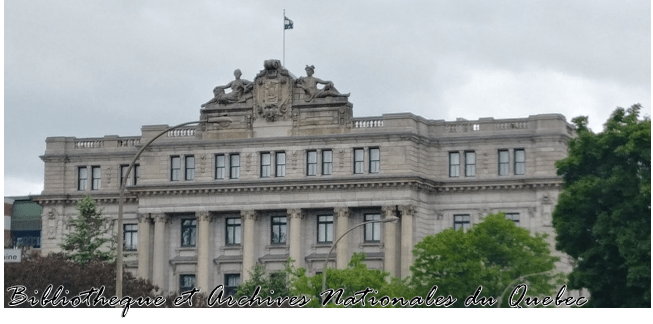
535, avenue Viger Est (East)
At first glance, this building didn’t catch my eye. But while reviewing my photos afterward, I noticed something special — intricate architectural details crowning the roof, and something rare in Montreal: 3D sculptures of a god and goddess reclining sideways along the top of the building. Their unexpected presence made me smile and instantly reminded me of the artistic flair found in European architecture.
Naturally, I had to do some digging — and I found even more to admire. Inaugurated in 1910, this building originally housed HEC Montréal (École des hautes études commerciales), a pioneering French-language business school made possible by Prime Minister Sir Lomer Gouin, who recognized the importance of creating French business education in Montreal. From 1970 to 1988, it became one of Dawson College’s campuses, and later it was transformed into what we now know as the Gilles Hocquart Building, home to the Bibliothèque et Archives nationales du Québec (BAnQ).
Update: I finally visited — and what a surprise. Inside, I was struck by the elegant wrought-iron railings, with their refined, swirling patterns lining staircases and balconies. And seeing the giant statues up close — Les géantes (see below) — was absolutely worth it. They’re both impressive, adding so much character to the ensemble.
Today, the building is primarily visited by those researching genealogy and Quebec history, but it’s also a quiet architectural gem. Now that I’ve seen it inside and out, I have a whole new appreciation for this beautiful and historic space.
Les géantes
The four monumental marble statues, known as Les géantes, were created in 1907–1908 by American sculptor Henry Augustus Lukeman to adorn the façade of the Royal Bank of Canada’s headquarters in Montreal (221, rue Saint-Jacques). Each 4-meter-tall female figure represents a pillar of Canada’s early 20th-century economy:
- Transport (holding a locomotive)
- Industry (with a pickaxe and oil lamp)
- Agriculture (holding wheat and a maple branch)
- Fishing (holding a trawler and flanked by a large fish)
Inspired by Greek classical art and reflecting the Beaux-Arts style, they symbolized economic prosperity and the prestige of banking institutions of that era. They were among the few works by Lukeman in Canada.
The statues were removed in 1991 during renovations and later recognized as cultural heritage in 1999 by Quebec’s Ministry of Culture. That same year, Power Corporation of Canada and the Desmarais family donated them to the Montreal archives and are now presented indoor in this building.
For an overview of Montreal click here.
For all posts on Montreal click here.
 Simple Travel and Recreation